Agentic AI in 2026: How Autonomous AI Agents Are Changing Software Development
Artificial Intelligence has evolved far beyond simple chatbots and text generation tools.
In 2026, one of the biggest shifts in the technology industry is the rise of Agentic AI — intelligent systems capable of making decisions, executing tasks, interacting with software, and continuously improving outcomes with minimal human intervention.
While Generative AI helped businesses create content, Agentic AI is helping businesses perform work.
This shift is expected to redefine how applications are built, how teams operate, and how software interacts with the real world.
In this guide, we will explore:
- What Agentic AI is
- How AI agents work
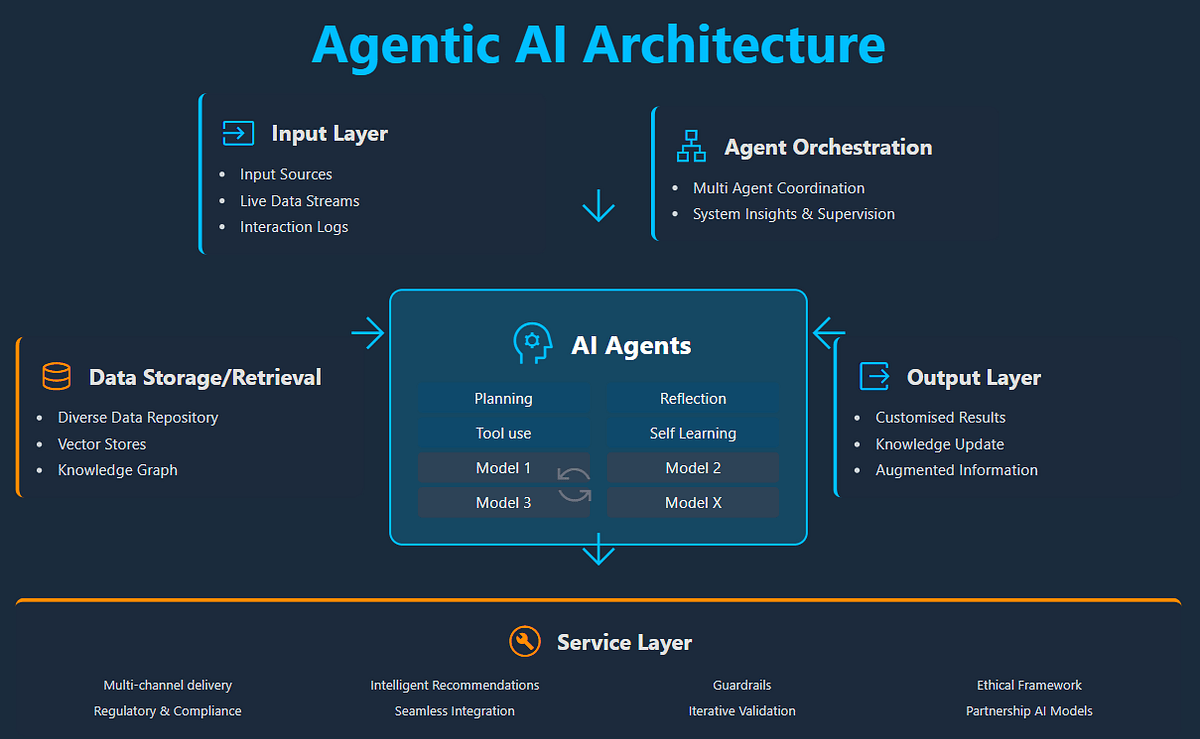
- Agentic AI architecture
- Real-world business applications
- Development frameworks
- Security challenges
- Future opportunities for developers
What is Agentic AI?
Agentic AI refers to artificial intelligence systems that can independently plan, reason, make decisions, and execute tasks to achieve a goal.
Unlike traditional AI systems that simply respond to prompts, AI agents actively determine what actions need to be taken.
For example, instead of asking an AI to write an email manually, an AI agent can:
- Read incoming messages
- Identify priority requests
- Generate responses
- Schedule meetings
- Update CRM records
- Notify relevant teams
All without requiring continuous human instructions.
Why Agentic AI Matters in 2026
Most businesses today struggle with repetitive processes spread across multiple software systems.
Employees spend significant time switching between applications, entering data, sending updates, and monitoring workflows.
Agentic AI eliminates much of this manual effort.
Instead of automating individual tasks, organizations can automate complete business processes.
How Agentic AI Differs from Traditional AI
Traditional AI Agentic AI Responds to prompts Acts toward goals Single interaction Multi-step reasoning Requires human guidance Operates autonomously Limited memory Maintains context Produces answers Produces outcomes How AI Agents Work
A modern AI agent generally follows a continuous cycle:
- Receive objective
- Analyze available information
- Create execution plan
- Use tools and APIs
- Evaluate results
- Adjust strategy if needed
- Complete objective
This process enables agents to solve complex tasks without needing human intervention at every step.
Core Components of Agentic AI Systems
1. Large Language Models (LLMs)
The reasoning engine behind the agent.
Popular options include:
- GPT Models
- Claude
- Gemini
- Open-source models
2. Memory Layer
Stores information from previous interactions.
This allows agents to remember users, projects, goals, and historical context.
3. Tool Integration Layer
Agents connect with:
- Databases
- CRMs
- Email systems
- Payment gateways
- Internal APIs
- Cloud platforms
4. Planning Engine
The planning layer breaks large goals into smaller executable tasks.
Real-World Applications of Agentic AI
Customer Support Automation
AI agents can manage complete customer support workflows.
- Read tickets
- Search knowledge bases
- Generate responses
- Escalate issues when necessary
Software Development
Development teams are increasingly using AI agents for:
- Code generation
- Bug fixing
- Test creation
- Documentation writing
- Pull request reviews
Recruitment
AI agents can screen resumes, schedule interviews, communicate with candidates, and maintain recruitment pipelines.
Sales Operations
- Lead qualification
- Email outreach
- Follow-up scheduling
- CRM updates
- Sales reporting
Popular Agentic AI Frameworks in 2026
- LangGraph
- CrewAI
- AutoGen
- OpenAI Agents SDK
- Semantic Kernel
- Haystack Agents
Example Architecture for an AI Agent Application
Frontend → Backend API → Agent Layer → Tools → Database → External Services
This architecture allows agents to safely interact with business systems while maintaining security controls.
Challenges of Agentic AI
Hallucinations
Agents may occasionally make incorrect assumptions.
Security Risks
Improper permissions can allow agents to perform unintended actions.
Cost Management
Complex reasoning tasks can increase AI inference costs.
Governance
Organizations must define clear boundaries regarding what agents can and cannot do.
Best Practices for Developers
- Use human approval for critical actions
- Implement role-based permissions
- Track every agent decision
- Maintain detailed logs
- Validate external data sources
- Limit autonomous actions initially
The Future of Agentic AI
Over the next few years, AI agents are expected to become standard components in enterprise software.
Instead of clicking through multiple dashboards, users will simply define objectives and allow agents to execute tasks.
Businesses that successfully adopt Agentic AI will gain significant advantages in productivity, scalability, and operational efficiency.
Final Thoughts
The transition from Generative AI to Agentic AI represents one of the most important technological shifts of this decade.
While Generative AI helped create information, Agentic AI is beginning to perform work.
Developers who learn how to build, manage, and secure AI agents today will be positioned at the center of the next generation of software innovation.
Agentic AI is no longer a future concept. It is rapidly becoming the operating system of modern business workflows.