The Ultimate Ethical Hacking & Cyber Security Handbook: Complete Roadmap for 2026
1. Introduction
Welcome to the digital frontier of 2026. The world we live in is powered entirely by lines of code, interconnected databases, distributed cloud systems, and automated machine learning models. Every transaction we make, every medical device keeping a patient alive, every electrical grid powering our cities, and every communication network binding our global society is mediated by software. In this hyper-connected ecosystem, security is no longer an afterthought or a secondary luxury; it is the fundamental core of stability. This handbook is a comprehensive, ground-up guide designed to transform you from a curious beginner into a highly skilled, professional ethical hacker and security engineer.
To defend these modern digital infrastructures, we must first learn how they are broken. This is the guiding philosophy of offensive security. Defensive engineering is reactive and incomplete without a thorough understanding of adversary tactics. By adopting the mindset of an attacker, you learn to spot the subtle logical flaws, misconfigured permissions, and unpatched vulnerabilities that traditional scanners miss. Throughout this handbook, we will demystify the complex technologies that make up modern IT environments, beginning with computer hardware and networking, and moving through operating systems, web application bugs, Active Directory, cloud security, reverse engineering, and AI-assisted security operations.
The term "hacker" carries a heavy burden of public misconception. Originally coined at MIT in the 1960s to describe clever engineering workarounds and optimizations, it was later popularized by media to refer exclusively to cybercriminals. In our industry, however, hacking remains a technical discipline of creative problem solving. Ethical hacking is the application of these skills for defensive benefit. Operating with explicit authorization, clear legal scoping, and a strict code of professional ethics, ethical hackers identify vulnerabilities before malicious actors (black hats) can exploit them, providing organizations with actionable blueprints for remediation.
The dual-use nature of security tools is a critical concept to understand. The exact same software used by a penetration tester to audit a network (like Nmap or Metasploit) can be used by an adversary to scan for vulnerability targets or execute arbitrary payloads. The difference is not the technology, but the intent and authorization. As an ethical hacker, you must always maintain a high standard of professional ethics. Every action you take must be backed by signed legal agreements and performed with the ultimate goal of improving system security.
Beginner Tip: Ethical hacking is not about running automated scripts you downloaded off GitHub. True hacking is about understanding protocols and systems so deeply that you can predict how they will behave when given unexpected inputs.
Professional Tip: Always secure your legal boundaries. Before starting any assessment, verify that you have a signed Scope of Work (SoW) and Rules of Engagement (RoE) document containing explicit authorization from the target system owner. Testing without authorization is a federal crime under statutes like the Computer Fraud and Abuse Act (CFAA), regardless of your intent.
Real-World Business Scenario
Consider a multinational financial corporation that ignored the importance of offensive security. They assumed that having standard firewalls and compliance audits was sufficient. A group of ethical hackers was hired to perform a black-box assessment. Within 48 hours, they identified a legacy staging server that was forgotten by the IT department but still connected to the production database. The ethical hackers demonstrated that an adversary could have leveraged this staging environment to exfiltrate millions of customer credit histories. This scenario highlights why organizations must proactively seek out their own blind spots.
AI Usage
In 2026, beginners use Gemini and Claude to understand the foundational theories of security, research historical attacks, and translate complex security jargon into plain language. AI models serve as 24/7 mentors, explaining how CPU registers operate during memory allocation or detailing the mechanics of historical breaches.
Common Mistakes
A common mistake for beginners is attempting to run exploitation scripts against systems without understanding the underlying protocol, which can easily crash critical corporate production services.
Best Practices
Always work within the boundaries of the signed Scope of Work. Never test external systems, cloud services, or employee portals that are not explicitly listed in the scoping documents.
Career Guidance
As you start your career, focus on building a strong understanding of computer architecture and networking. Certifications like CompTIA Security+ or eLearnSecurity eJPT provide an excellent baseline to demonstrate your commitment to employers.
Industry Standards & Recommended Tools
Professional operations in this domain rely heavily on compliance with standardized frameworks and the use of industry-accepted tools. The primary industry standards governing this area include ISO/IEC 27001 (Information Security Management), NIST Cybersecurity Framework (CSF) 2.0, and CIS Critical Security Controls.. To implement these standards, engineers utilize a suite of recommended tools, including Keep Security News Aggregators, threat feeds, and framework documentation handy., which allow for automated compliance checks, scanning, and operational verification. Following these standards ensures that security assessments and system configurations remain uniform, reliable, and auditable by third-party compliance agencies.
Future Trends (2026 & Beyond)
Looking forward, this domain will be shaped by several emerging technological shifts. The most prominent trend is The virtualization of security policy audits and the continuous integration of automation tools into corporate management frameworks.. As systems scale and threats grow in complexity, relying on manual processes is no longer viable. Organizations are investing heavily in automated, real-time security configurations that can adapt to changing conditions dynamically. Security practitioners must continuously update their skills to master these emerging architectures, ensuring they can defend the next generation of digital infrastructure.
2. Why Cyber Security Matters in 2026
In 2026, the reliance of modern society on digital systems has reached a critical tipping point. A security failure today does not merely mean compromised databases or stolen password hashes; it can translate directly to physical disruption, financial chaos, and loss of life. From self-driving delivery trucks and municipal water systems to smart grids and automated financial markets, the digital world is directly integrated with physical reality. Consequently, securing this digital infrastructure is a vital priority for businesses, governments, and individuals alike.
For businesses, the financial impact of a breach has grown exponential. When an enterprise is compromised by ransomware, the direct costs include forensic audits, legal consulting fees, ransom demands (which are increasingly illegal to pay under modern regulatory frameworks), and business interruption. More critically, the reputational damage can devastate a company. In 2026, customers are highly aware of data privacy issues. A business that suffers a major, preventable breach faces immediate loss of client trust, dropping stock valuations, and severe regulatory fines under frameworks such as the EU's GDPR, California's CCPA, and global financial standards, which can reach up to 4% of an organization's global annual revenue.
Beyond direct financial losses, the legal liability for corporate officers has increased. Regulatory bodies now hold directors and executives personally accountable if they fail to implement basic security hygiene. This has caused a massive shift in corporate governance, where security metrics are reported directly to the board of directors and are integrated into the company's overall risk management framework.
Moreover, cyber insurance providers have drastically tightened their underwriting requirements. In 2026, companies can no longer buy policies to simply offset their cyber risk. Insurers require strict proof of proactive controls—such as multi-factor authentication (MFA), continuous endpoint logging (EDR), and regular penetration testing—before they will underwrite an organization.
Common Mistake: Operating under the belief that "our company is too small to be a target." Modern cybercriminals do not manually select every target. They use automated scanners that continuously sweep the global IP address spaces (IPv4 and IPv6) looking for unpatched systems, exposed cloud buckets, or default administrative credentials. If your system is connected to the internet and contains a vulnerability, it will be discovered.
Best Practice: Shift from a boundary-based perimeter security model to a Zero Trust Architecture (ZTA). Treat all networks—including internal corporate offices—as hostile. Every user, device, and API call must be authenticated, authorized based on least privilege, and continuously verified before gaining access to resources.
Real-World Business Scenario
In 2026, a major cloud provider suffered a misconfiguration breach in their storage systems, exposing the unencrypted health records of over 10 million patients. The immediate business impact included a 15% drop in the company's stock value, $45 million in forensic investigation and recovery costs, and an additional $20 million in regulatory fines under data privacy regulations. This event demonstrated that proactive security investments are a fraction of the cost of breach recovery.
AI Usage
Security teams use AI agents to automate the generation of compliance reports and analyze cloud infrastructure configurations, checking them against industry standards like CIS Benchmarks.
Common Mistakes
Many developers assume that internal-only databases do not require authentication because they are shielded by the corporate network. If an attacker gains initial access, these unauthenticated internal databases are immediately compromised.
Best Practices
Implement encryption for data at rest and in transit. Enforce multi-factor authentication (MFA) across all corporate interfaces, and run continuous vulnerability scans.
Career Guidance
Understanding the business impact of security risks is a key differentiator for senior engineers. Focus on learning risk governance frameworks (such as NIST CSF) to communicate technical issues to executive management.
Industry Standards & Recommended Tools
Professional operations in this domain rely heavily on compliance with standardized frameworks and the use of industry-accepted tools. The primary industry standards governing this area include ISO/IEC 27001 (Information Security Management), NIST Cybersecurity Framework (CSF) 2.0, and CIS Critical Security Controls.. To implement these standards, engineers utilize a suite of recommended tools, including Keep Security News Aggregators, threat feeds, and framework documentation handy., which allow for automated compliance checks, scanning, and operational verification. Following these standards ensures that security assessments and system configurations remain uniform, reliable, and auditable by third-party compliance agencies.
Future Trends (2026 & Beyond)
Looking forward, this domain will be shaped by several emerging technological shifts. The most prominent trend is The virtualization of security policy audits and the continuous integration of automation tools into corporate management frameworks.. As systems scale and threats grow in complexity, relying on manual processes is no longer viable. Organizations are investing heavily in automated, real-time security configurations that can adapt to changing conditions dynamically. Security practitioners must continuously update their skills to master these emerging architectures, ensuring they can defend the next generation of digital infrastructure.
3. Current Cyber Threat Landscape
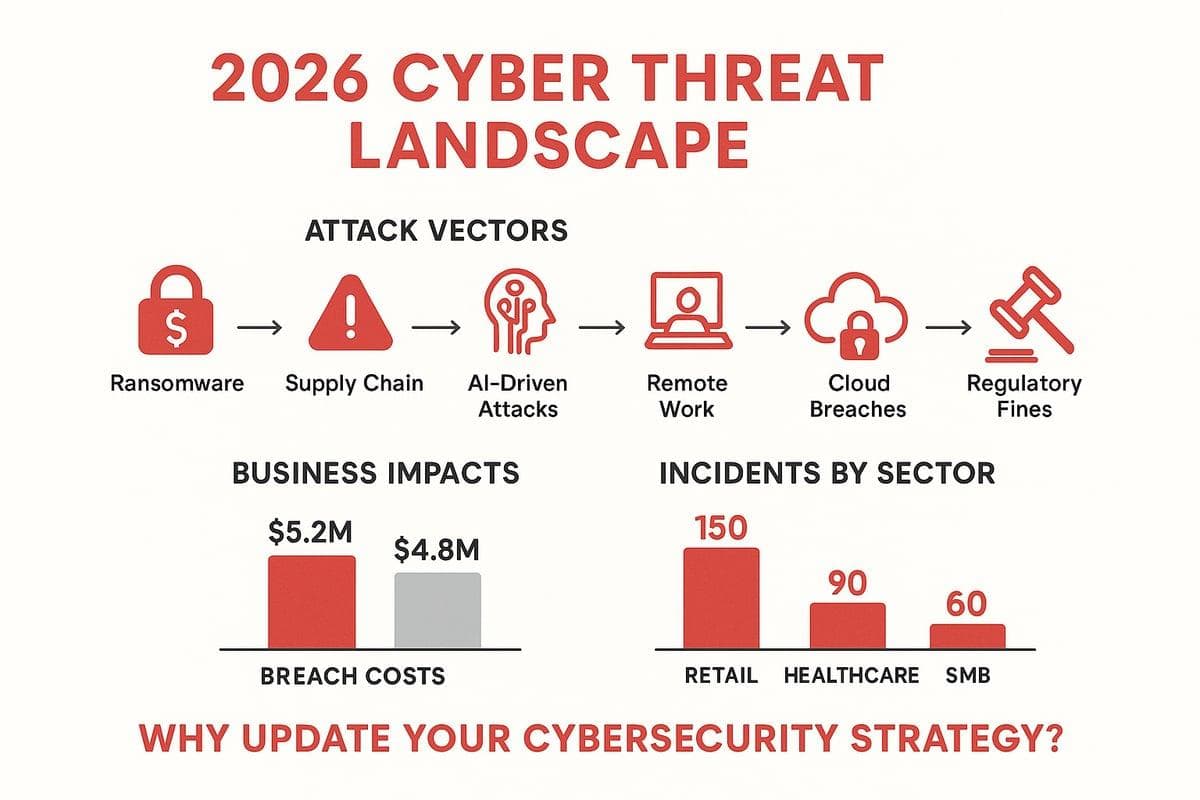
The cyber threat landscape of 2026 is characterized by its scale, speed, and corporate-like organization. Threat actors are no longer individual hobbyists; they are structured, highly resourced cybercriminal syndicates operating like software companies, and state-sponsored Advanced Persistent Threats (APTs) executing geopolitical campaigns. These groups share tools on dark web networks and exploit new architectures as soon as they are deployed.
Key threats defining the current landscape include:
- Ransomware-as-a-Service (RaaS): Ransomware operations are split into developers (who write the encryption software and run payment gateways) and affiliates (who compromise networks and deploy the malware). This division of labor allows attackers to launch highly coordinated campaigns at scale.
- Triple Extortion: Attackers do not just encrypt systems. They exfiltrate sensitive files and threaten to leak them, and launch Distributed Denial of Service (DDoS) attacks against the victim's client face if they refuse to negotiate, applying extreme pressure.
- Supply Chain Attacks: Compromising a third-party software library, build pipeline, or SaaS vendor to gain access to thousands of downstream companies simultaneously.
- AI-Generated Threats: Generative AI models are weaponized to generate highly tailored phishing templates (spear-phishing), rewrite malware dynamically to evade antivirus signatures (polymorphic malware), and automate exploit searches.
We also see a significant rise in initial access brokers (IABs). These are specialized attackers who focus exclusively on breaching corporate networks, establishing persistence, and then selling access to ransomware operators or state-sponsored groups. This monetization has made attacks faster and more efficient, as threat groups no longer need to perform the initial reconnaissance phase themselves.
Beginner Tip: Use the MITRE ATT&CK framework to study real-world adversary behavior. It catalogs real-world tactics, techniques, and procedures (TTPs), helping you understand how attackers gain access, escalate privilege, and exfiltrate data.
Professional Tip: Focus on reducing the blast radius of a breach. Implement micro-segmentation in your network, isolate critical assets, deploy Endpoint Detection and Response (EDR) agents, and maintain immutable, offline backups. Assume that a breach will occur, and build systems that contain it before it spreads.
Real-World Business Scenario
A global logistics company fell victim to a ransomware attack. The attackers gained initial access through a spear-phishing campaign that targeted a HR coordinator using an AI-generated voice clone. Once inside, the ransomware encrypted the shipping routing databases, bringing deliveries to a halt. The attackers demanded a $10 million ransom and threatened to release proprietary business contracts. The company was forced to pivot to manual tracking methods, suffering millions in daily operational losses before containing the breach.
AI Usage
Defenders deploy machine learning pipelines to detect polymorphic malware signatures and recognize abnormal network traffic patterns that suggest data exfiltration.
Common Mistakes
Relying only on static, signature-based antivirus solutions. Modern malware changes its binary structure dynamically, easily bypassing traditional antivirus databases.
Best Practices
Deploy Endpoint Detection and Response (EDR) agents on all workstations, segment your networks to restrict lateral movement, and keep offline, immutable backups.
Career Guidance
Threat intelligence analysts are in high demand. Learn how to parse STIX/TAXII feeds and use open-source threat sharing platforms like MISP to stay ahead of active adversary campaigns.
Industry Standards & Recommended Tools
Professional operations in this domain rely heavily on compliance with standardized frameworks and the use of industry-accepted tools. The primary industry standards governing this area include ISO/IEC 27001 (Information Security Management), NIST Cybersecurity Framework (CSF) 2.0, and CIS Critical Security Controls.. To implement these standards, engineers utilize a suite of recommended tools, including Keep Security News Aggregators, threat feeds, and framework documentation handy., which allow for automated compliance checks, scanning, and operational verification. Following these standards ensures that security assessments and system configurations remain uniform, reliable, and auditable by third-party compliance agencies.
Future Trends (2026 & Beyond)
Looking forward, this domain will be shaped by several emerging technological shifts. The most prominent trend is The virtualization of security policy audits and the continuous integration of automation tools into corporate management frameworks.. As systems scale and threats grow in complexity, relying on manual processes is no longer viable. Organizations are investing heavily in automated, real-time security configurations that can adapt to changing conditions dynamically. Security practitioners must continuously update their skills to master these emerging architectures, ensuring they can defend the next generation of digital infrastructure.
4. What Is Ethical Hacking
Ethical hacking is the authorized, systematic practice of identifying, analyzing, and exploiting vulnerabilities in an organization's digital assets. The ultimate goal is to discover security flaws before malicious threat actors can find them, and to provide actionable guidance to secure those systems. The primary differentiator between ethical hacking and malicious hacking is authorization. An ethical hacker operates under a strict legal contract with the explicit consent of the system owner.
Before any technical testing begins, several critical documents must be drafted and signed:
- Scope of Work (SoW): Defines the boundaries of the test. It lists the exact IP addresses, domain names, APIs, physical buildings, or employee accounts that are allowed to be tested. It also explicitly names out-of-scope targets that must not be touched.
- Rules of Engagement (RoE): Establishes the guidelines for the assessment, specifying the hours of testing, tools allowed, communication channels, and emergency contacts in case of system failure.
- Non-Disclosure Agreement (NDA): A legal contract protecting the confidentiality of all data, vulnerabilities, and information discovered during the test.
Following the assessment, the ethical hacker compiles a detailed technical report. This document includes an Executive Summary translating risks into business impact, a detailed list of all vulnerabilities found, step-by-step reproduction instructions (Proof of Concept), and specific, actionable recommendations on how the development and administration teams can patch the issues.
Ethical hackers utilize a variety of methodologies depending on the level of information provided about the target:
- Black Box Testing: The tester has no prior knowledge of the target network or application structure. This mimics a realistic external attack, requiring the tester to perform extensive reconnaissance.
- White Box Testing: The tester is given full access to documentation, network maps, configuration files, and source code. This allows for a deep, exhaustive audit of the system.
- Grey Box Testing: The tester has limited information, such as standard user login credentials. This mimics an insider threat or an attacker who has compromised a user account.
Recommended Tools: Nmap (for network discovery), Burp Suite Pro (for web application analysis), Metasploit Framework (for exploit development and execution), and Wireshark (for network packet analysis).
Real-World Business Scenario
An e-commerce retailer hired a team of penetration testers to assess their payment gateway before the holiday shopping season. During the test, the ethical hackers identified a critical injection vulnerability that allowed users to modify the prices of items in the cart. Because this was discovered during a controlled test, the company patched the vulnerability before launch, preventing potential losses of hundreds of thousands of dollars.
AI Usage
Ethical hackers use AI to write custom scripts to interact with proprietary protocols and automate the generation of technical findings reports.
Common Mistakes
Conducting security assessments without a signed legal authorization document. Without signed scoping contracts, your testing is illegal, regardless of your defensive intent.
Best Practices
Always establish clear Rules of Engagement, keep stakeholders updated during testing, and double-check your IP scope before running active scans.
Career Guidance
To succeed as a penetration tester, build a portfolio of public work. Participate in bug bounty programs, document your findings in write-ups, and share your open-source tools on GitHub.
Industry Standards & Recommended Tools
Professional operations in this domain rely heavily on compliance with standardized frameworks and the use of industry-accepted tools. The primary industry standards governing this area include ISO/IEC 27001 (Information Security Management), NIST Cybersecurity Framework (CSF) 2.0, and CIS Critical Security Controls.. To implement these standards, engineers utilize a suite of recommended tools, including Keep Security News Aggregators, threat feeds, and framework documentation handy., which allow for automated compliance checks, scanning, and operational verification. Following these standards ensures that security assessments and system configurations remain uniform, reliable, and auditable by third-party compliance agencies.
Future Trends (2026 & Beyond)
Looking forward, this domain will be shaped by several emerging technological shifts. The most prominent trend is The virtualization of security policy audits and the continuous integration of automation tools into corporate management frameworks.. As systems scale and threats grow in complexity, relying on manual processes is no longer viable. Organizations are investing heavily in automated, real-time security configurations that can adapt to changing conditions dynamically. Security practitioners must continuously update their skills to master these emerging architectures, ensuring they can defend the next generation of digital infrastructure.
5. Difference Between Ethical Hacking and Cyber Security
Although the public often conflates "Cyber Security" and "Ethical Hacking," they represent distinct roles and focus areas within the technology sector. Cyber security is the broad, overarching umbrella that encompasses all practices, policies, technologies, and strategies aimed at protecting digital assets from theft, damage, or unauthorized access. It includes risk management, compliance, security governance, architecture design, and system administration.
Ethical hacking, on the other hand, is a specific, active discipline under the cyber security umbrella. It is offensive in nature (often referred to as "offensive security" or "Red Teaming"). While a cyber security architect designs and builds a secure network using firewalls, access controls, and encryption, an ethical hacker's job is to attempt to bypass those exact defenses to prove whether they are truly effective. Think of cyber security as the design and construction of a high-security vault, while ethical hacking is the hiring of a professional safecracker to test the vault's resilience under realistic attack conditions.
Defensive cybersecurity operations (often called Blue Teaming) focus on vulnerability management, patching systems, setting up intrusion detection systems (IDS), configuring firewalls, and managing identities and access. Defensive engineers work with compliance frameworks (such as ISO 27001, SOC 2, and NIST CSF) to align security controls with business objectives. Offensive testers (Red Teaming) focus on exploiting gaps in these systems to demonstrate risks. Both disciplines are essential for a robust security posture, forming a feedback loop where offensive discoveries drive defensive improvements.
FeatureCyber Security (Defensive/Governance)Ethical Hacking (Offensive Security)Core FocusDefense, policy, architecture, and monitoring.Offensive testing, vulnerability discovery, and exploitation.ApproachProactive defense and reactive incident response.Simulated attacks mimicking malicious actors.Primary OutputSecure systems, compliance reports, and incident logs.Penetration testing reports and Proofs of Concept (PoCs).TechniquesPatching, monitoring, IAM, firewall configuration.Exploitation, social engineering, privilege escalation. Real-World Business Scenario
A healthcare company built a secure patient portal with strong encryption and firewalls, but failed to conduct offensive testing. A security engineer later performed a web penetration test and discovered that although the database was encrypted, the application API allowed any authenticated user to retrieve other patients' records by changing a ID number in the request parameter. This demonstrated that while the cybersecurity team built solid encryption defenses, the offensive test was necessary to identify the logical bypass.
AI Usage
AI helps blue teams correlate network security logs while assisting red teams in simulating adversary behaviors.
Common Mistakes
Treating cybersecurity and ethical hacking as competing silos. Defensive and offensive teams must collaborate to share threat data and patch vulnerabilities effectively.
Best Practices
Create a Purple Team framework where offensive testers and defenders collaborate during exercises to improve the overall corporate defense.
Career Guidance
Broaden your expertise by learning both offensive and defensive disciplines. Understanding both sides makes you a highly valuable asset to security teams.
Industry Standards & Recommended Tools
Professional operations in this domain rely heavily on compliance with standardized frameworks and the use of industry-accepted tools. The primary industry standards governing this area include ISO/IEC 27001 (Information Security Management), NIST Cybersecurity Framework (CSF) 2.0, and CIS Critical Security Controls.. To implement these standards, engineers utilize a suite of recommended tools, including Keep Security News Aggregators, threat feeds, and framework documentation handy., which allow for automated compliance checks, scanning, and operational verification. Following these standards ensures that security assessments and system configurations remain uniform, reliable, and auditable by third-party compliance agencies.
Future Trends (2026 & Beyond)
Looking forward, this domain will be shaped by several emerging technological shifts. The most prominent trend is The virtualization of security policy audits and the continuous integration of automation tools into corporate management frameworks.. As systems scale and threats grow in complexity, relying on manual processes is no longer viable. Organizations are investing heavily in automated, real-time security configurations that can adapt to changing conditions dynamically. Security practitioners must continuously update their skills to master these emerging architectures, ensuring they can defend the next generation of digital infrastructure.
6. Types of Hackers
The hacking community is traditionally categorized using "hat" metaphors, which describe the ethical boundaries, legality, and motivations behind a hacker's activities. Understanding these distinctions is critical for defining your professional identity and understanding the legal ramifications of security research.
White Hat Hackers: These are the ethical hackers. They operate with full permission, clear authorization, and legal contracts. Their goal is to identify security vulnerabilities and report them responsibly to organization owners so they can be patched. They adhere strictly to laws such as the Computer Fraud and Abuse Act (CFAA) in the US and equivalent international frameworks.
Black Hat Hackers: These are malicious threat actors. They break into systems without authorization for personal gain, monetary theft, corporate espionage, or geopolitical disruption. Their activities are entirely illegal and carry severe criminal penalties.
Grey Hat Hackers: These individuals occupy a middle ground. They often scan networks and find vulnerabilities without the owner's permission, but they do not exploit them maliciously. Instead, they might contact the owner to report the flaw, sometimes requesting a fee to disclose the full details, or publicly exposing the bug if the company ignores them. While their intentions might not be malicious, their actions are still illegal due to the lack of explicit authorization.
State-Sponsored Hackers: Advanced actors employed by governments to conduct cyber warfare, intelligence gathering, and infrastructure disruption against foreign nations. They target critical infrastructure, defense networks, and government services.
Hacktivists: Hackers motivated by political, social, or religious ideologies who deface websites, leak confidential documents, or execute DDoS attacks to draw attention to their cause.
Insider Threats: Employees, contractors, or business partners who abuse their authorized access to steal corporate secrets, disrupt operations, or expose sensitive data. Insiders can be malicious (seeking personal gain) or negligent (falling victim to social engineering attacks).
Real-World Business Scenario
A corporate insider, unhappy about being passed over for a promotion, used his administrator credentials to delete critical backup configurations and leak proprietary source code to a competitor. This insider threat bypassed all external firewalls and network segmentation controls, demonstrating that security strategies must protect against internal threats as well as external adversaries.
AI Usage
Organizations use AI behavioral models to monitor employee network patterns and detect potential insider threats or compromised corporate credentials.
Common Mistakes
Assuming that all security threats originate from outside the network. Insider actions, whether malicious or accidental, account for a large percentage of data breaches.
Best Practices
Enforce strict access controls, limit administrative privileges, and implement continuous user behavior monitoring across all internal environments.
Career Guidance
Understanding the psychology and motivations of different hacker classifications helps security architects build targeted, realistic threat models.
Industry Standards & Recommended Tools
Professional operations in this domain rely heavily on compliance with standardized frameworks and the use of industry-accepted tools. The primary industry standards governing this area include ISO/IEC 27001 (Information Security Management), NIST Cybersecurity Framework (CSF) 2.0, and CIS Critical Security Controls.. To implement these standards, engineers utilize a suite of recommended tools, including Keep Security News Aggregators, threat feeds, and framework documentation handy., which allow for automated compliance checks, scanning, and operational verification. Following these standards ensures that security assessments and system configurations remain uniform, reliable, and auditable by third-party compliance agencies.
Future Trends (2026 & Beyond)
Looking forward, this domain will be shaped by several emerging technological shifts. The most prominent trend is The virtualization of security policy audits and the continuous integration of automation tools into corporate management frameworks.. As systems scale and threats grow in complexity, relying on manual processes is no longer viable. Organizations are investing heavily in automated, real-time security configurations that can adapt to changing conditions dynamically. Security practitioners must continuously update their skills to master these emerging architectures, ensuring they can defend the next generation of digital infrastructure.
7. Career Opportunities
The demand for cyber security professionals in 2026 has reached an all-time high, driven by the rapid adoption of cloud technologies, IoT, and automated pipelines. Choosing a career in this field offers diverse pathways, competitive salaries, and high job security, as companies struggle to find qualified candidates to defend their infrastructures.
Prospective security professionals can target various roles depending on their interests:
- Penetration Tester (Ethical Hacker): Focuses on assessing applications, networks, and physical security by finding and exploiting vulnerabilities.
- Security Engineer / Architect: Designs, builds, and maintains security systems, ensuring secure coding practices and solid infrastructure layouts.
- SOC Analyst (Security Operations Center): Monitors real-time alerts, detects potential security incidents, and responds to threats on the network.
- Incident Responder: The digital firefighter who steps in immediately after a breach has occurred to contain the damage, evict the attacker, and restore operations.
- Application Security (AppSec) Specialist: Works closely with software developers to perform secure code reviews, set up automated SAST/DAST tooling, and secure the CI/CD pipeline.
Within these roles, security practitioners can advance along technical or management tracks. The technical track leads to senior engineering and architect positions, focusing on deep specialized research. The management track leads to roles like Security Manager, Security Director, and ultimately Chief Information Security Officer (CISO), directing the corporate security strategy.
Career Guidance: If you enjoy break-fix scenarios, exploring code vulnerabilities, and thinking outside the box, target Penetration Testing or Bug Bounty hunting. If you prefer building systems, analyzing logs, and engineering defenses, look into Blue Teaming, DevSecOps, or Cloud Security engineering.
Real-World Business Scenario
A tech startup was preparing for a major funding round when they realized they lacked a dedicated security lead. They hired a Security Engineer who set up secure coding guidelines, hardened their cloud infrastructure, and configured logging. This proactive security alignment helped the company pass the due diligence audit of the investors, securing the funding round.
AI Usage
Recruiters use AI tools to screen resumes for specific security certifications and technical competencies, making structured portfolios critical for applicants.
Common Mistakes
Failing to specialize in a specific domain. While a broad security baseline is necessary, employers seek specialists in areas like Cloud Security, AppSec, or Incident Response.
Best Practices
Earn industry-recognized certifications, build a personal lab to gain hands-on experience, and network with professionals at local security meetups.
Career Guidance
Determine your career interests early. If you enjoy building and monitoring, target defensive engineering. If you enjoy break-fix scenarios, focus on offensive penetration testing.
Industry Standards & Recommended Tools
Professional operations in this domain rely heavily on compliance with standardized frameworks and the use of industry-accepted tools. The primary industry standards governing this area include ISO/IEC 27001 (Information Security Management), NIST Cybersecurity Framework (CSF) 2.0, and CIS Critical Security Controls.. To implement these standards, engineers utilize a suite of recommended tools, including Keep Security News Aggregators, threat feeds, and framework documentation handy., which allow for automated compliance checks, scanning, and operational verification. Following these standards ensures that security assessments and system configurations remain uniform, reliable, and auditable by third-party compliance agencies.
Future Trends (2026 & Beyond)
Looking forward, this domain will be shaped by several emerging technological shifts. The most prominent trend is The virtualization of security policy audits and the continuous integration of automation tools into corporate management frameworks.. As systems scale and threats grow in complexity, relying on manual processes is no longer viable. Organizations are investing heavily in automated, real-time security configurations that can adapt to changing conditions dynamically. Security practitioners must continuously update their skills to master these emerging architectures, ensuring they can defend the next generation of digital infrastructure.
8. How AI Changed Ethical Hacking
The integration of Artificial Intelligence into the cybersecurity domain has transformed ethical hacking from a manual, time-consuming craft into a highly automated, speed-of-light operation. In 2026, AI is no longer a futuristic concept; it is an active collaborator. Ethical hackers and security engineers use generative AI models and custom machine learning pipelines to automate reconnaissance, parse complex logs, generate proof-of-concept code, and write technical findings. By utilizing AI, security professionals can accomplish in hours what used to take days, shifting their focus from repetitive tasks to complex, creative logical bypasses.
Let us examine the specific tools and workflows that define modern AI-assisted security engineering:
- How ChatGPT Helps Ethical Hackers: ChatGPT is widely utilized as a real-time scripting assistant and debugging partner. When a penetration tester is on an engagement and encounters a custom proprietary protocol, they can feed packet structures to ChatGPT and request a customized Python parser or fuzzing script. It also serves as a rapid brainstorming partner for developing payload ideas to bypass Web Application Firewalls (WAFs) and endpoint filters.
- How Claude Helps Security Engineers: With its large context window and advanced logical reasoning capabilities, Claude is the industry favorite for application security engineering. Engineers upload large codebases, system architectures, or configuration files (such as complex Kubernetes YAMLs or Terraform files) to Claude to conduct deep security reviews, trace data flows to check for injection points, and design threat models.
- How Gemini Helps learning: Gemini's integration with Google's search infrastructure makes it an ideal research and learning assistant. For beginners and professionals alike, Gemini is used to demystify complex, newly disclosed CVEs (Common Vulnerabilities and Exposures). When a new vulnerability is announced, Gemini can rapidly fetch, summarize, and explain the underlying mechanics, compiling a list of resources, blog posts, and GitHub repositories containing proof-of-concept scripts.
- AI-assisted penetration testing: AI agents are now deployed during the reconnaissance phase of a penetration test. These agents can run tools like Nmap, automatically analyze open ports, identify running services, match them against vulnerability databases, and recommend specific exploits. Instead of running commands sequentially, testers can leverage AI to run concurrent, context-aware workflows.
- AI-assisted code review: Security teams integrate AI checkers directly into the CI/CD pipeline. These tools analyze code changes on every pull request, finding syntax issues, insecure dependency usage, hardcoded credentials, and architectural flaws, preventing vulnerable code from reaching production.
- AI-assisted report writing: Writing reports is traditionally the most tedious part of a security assessment. AI models streamline this by transforming raw technical logs and command histories into professional, executive-friendly summaries, technical breakdown descriptions, and step-by-step remediation plans formatted in clean markdown or HTML.
- AI-assisted malware analysis: Reverse engineers use AI to analyze decompiled code. Passing complex, obfuscated assembly or decompiled C code from tools like Ghidra or IDA Pro to AI helps reconstruct control flows, rename obfuscated variables, explain cryptographic routines, and identify the core behavior of the malware in seconds.
- AI-assisted log analysis, SOC, & Threat Hunting: Modern Security Operations Centers (SOCs) are flooded with millions of alerts daily. AI filters the noise, correlating disjointed events across the network—such as an unusual login from an external IP followed by a sudden increase in encrypted database queries—and flags it as a unified threat campaign. AI-assisted threat hunters query database logs using natural language to spot subtle anomalies indicating lateral movement by attackers.
Real-World Business Scenario
During a Red Team engagement, the security team used an AI scripting assistant to generate a custom fuzzer for an obscure legacy system. The fuzzer identified a buffer overflow vulnerability in less than an hour, allowing the team to demonstrate a critical compromise path that would have taken days to find manually.
AI Usage
Generative AI tools write helper scripts, customize exploit payloads, parse complex logs, and drafts report findings in structured formats.
Common Mistakes
Copying and pasting sensitive client source code or credentials into public AI models, which violates client privacy and data protection agreements.
Best Practices
Deploy local, self-hosted open-source AI models on secure hardware to analyze sensitive code or configuration data.
Career Guidance
Stay updated on AI advancements. Learning how to integrate AI tools into your daily security workflows is a highly valued skill in modern security operations.
Industry Standards & Recommended Tools
Professional operations in this domain rely heavily on compliance with standardized frameworks and the use of industry-accepted tools. The primary industry standards governing this area include OWASP Top 10 for LLMs, MITRE ATLAS framework, and the draft standards of ISO/IEC 42001 (Artificial Intelligence Management System).. To implement these standards, engineers utilize a suite of recommended tools, including Ollama (for local model deployments), LangChain Security Checkers, and adversarial robustness testing toolkits., which allow for automated compliance checks, scanning, and operational verification. Following these standards ensures that security assessments and system configurations remain uniform, reliable, and auditable by third-party compliance agencies.
Future Trends (2026 & Beyond)
Looking forward, this domain will be shaped by several emerging technological shifts. The most prominent trend is Self-healing code pipelines where AI models identify, verify, patch, and test vulnerabilities without human intervention, and the rise of autonomous attacker agents.. As systems scale and threats grow in complexity, relying on manual processes is no longer viable. Organizations are investing heavily in automated, real-time security configurations that can adapt to changing conditions dynamically. Security practitioners must continuously update their skills to master these emerging architectures, ensuring they can defend the next generation of digital infrastructure.
9. Can AI Replace Ethical Hackers?
Despite the massive advancements in AI automation, the short answer is no: AI cannot replace skilled ethical hackers in 2026. While AI is exceptionally efficient at pattern recognition, rapid code generation, and processing vast amounts of structured data, it lacks the creative intuition, context awareness, and outside-the-box thinking that characterizes human ingenuity. Cybersecurity is fundamentally a game of logic, psychology, and physical constraints. Human attackers do not just follow checklists; they find unique gaps in the business logic, manipulate human psychology through social engineering, and chain minor, low-severity issues together to achieve a full system compromise.
Consider the following limitations and risks associated with AI in cybersecurity:
- AI Limitations & Hallucinations: Large Language Models generate text based on statistical probability, not actual comprehension. This makes them prone to "hallucinations"—generating confident but completely incorrect statements, non-existent CVEs, or security configurations that contain hidden vulnerabilities. A developer relying blindly on AI-generated security fixes might accidentally introduce a remote code execution vulnerability.
- Inability to Understand Business Context: An AI scanner can flag that an internal database does not require authentication. However, it cannot evaluate whether this is a critical security vulnerability or an intentional, isolated test dataset that contains no real data and is blocked by physical network segmentation. Humans must provide the necessary context to separate minor alerts from severe security incidents.
- The Adversarial Weaponization of AI: It is crucial to remember that malicious threat actors are using AI just as actively. Black-hats use AI to write polymorphic malware that changes its signature dynamically to evade EDR systems, write convincing phishing emails, and automate brute-force attacks against cloud interfaces. Defense must always be one step ahead, which requires deep human coordination, engineering, and tactical decision-making.
- Ethics of AI in Security: Utilizing AI in security research introduces serious ethical and privacy concerns. Uploading proprietary client code, sensitive network configurations, or personal data to public AI APIs can violate non-disclosure agreements, data compliance regulations (such as GDPR or HIPAA), and compromise client confidentiality. Security professionals must use self-hosted, offline AI models or enterprise instances with guaranteed data protection terms.
Furthermore, security auditing requires high levels of trust. Clients trust human professionals to handle sensitive data, perform live tests without breaking production environments, and present the results in a clear context. An AI system cannot participate in a corporate board meeting, handle a sensitive political context, or negotiate scoping terms with a client.
Professional Tip: When using AI tools for security analysis, never copy-paste sensitive client data or proprietary code directly into public generative AI engines. Deploy localized, open-source models (such as LLaMA or Mistral) on your own secure infrastructure to maintain complete data privacy.
Beginner Tip: Treat AI as a highly competent intern. Verify every script, exploit, and command it provides before running it in a production or lab environment. Blindly executing AI-generated commands is a quick way to crash services or lock yourself out of a target system.
Real-World Business Scenario
An automated AI scanning tool reviewed a financial application and marked it as secure. However, a human penetration tester later identified that by manipulating the session cookie values, they could access other users' banking profiles. The AI scanner missed this because it lacked the logical reasoning to understand the application's unique business context, demonstrating the necessity of human security experts.
AI Usage
Ethical hackers use AI to process raw data and scan for common, known vulnerability patterns, allowing human testers to focus on finding complex logical bypasses.
Common Mistakes
Assuming that automated vulnerability scanners can replace manual testing. Scanners are useful for baseline audits, but fail to find deep, custom business logic flaws.
Best Practices
Combine automated vulnerability scanning with regular manual penetration testing to achieve complete security coverage.
Career Guidance
Focus on developing deep analytical thinking and creative problem-solving skills. These human-centric capabilities are what make you irreplaceable by AI automation.
Industry Standards & Recommended Tools
Professional operations in this domain rely heavily on compliance with standardized frameworks and the use of industry-accepted tools. The primary industry standards governing this area include OWASP Top 10 for LLMs, MITRE ATLAS framework, and the draft standards of ISO/IEC 42001 (Artificial Intelligence Management System).. To implement these standards, engineers utilize a suite of recommended tools, including Ollama (for local model deployments), LangChain Security Checkers, and adversarial robustness testing toolkits., which allow for automated compliance checks, scanning, and operational verification. Following these standards ensures that security assessments and system configurations remain uniform, reliable, and auditable by third-party compliance agencies.
Future Trends (2026 & Beyond)
Looking forward, this domain will be shaped by several emerging technological shifts. The most prominent trend is Self-healing code pipelines where AI models identify, verify, patch, and test vulnerabilities without human intervention, and the rise of autonomous attacker agents.. As systems scale and threats grow in complexity, relying on manual processes is no longer viable. Organizations are investing heavily in automated, real-time security configurations that can adapt to changing conditions dynamically. Security practitioners must continuously update their skills to master these emerging architectures, ensuring they can defend the next generation of digital infrastructure.
10. Complete Beginner Learning Roadmap
Embarking on a journey into ethical hacking can feel overwhelming due to the sheer volume of concepts, tools, and platforms available. Many beginners fail because they jump straight to running advanced exploitation tools without understanding the underlying technologies. To build a successful, long-term career in cybersecurity, you must follow a structured path that builds from foundational systems knowledge to advanced offensive and defensive techniques.
A modern roadmap for mastering ethical hacking is broken down into five distinct phases:
- Phase 1: IT & System Foundations: Master computer fundamentals, operating systems (Linux and Windows), networking, and basic programming (Python/Bash). You cannot hack what you do not understand.
- Phase 2: Web & Security Foundations: Understand how the web works (HTML, HTTP, APIs) and dive deep into OWASP Top 10 vulnerabilities, authentication methods, and database query concepts.
- Phase 3: Infrastructure & Cloud: Learn Active Directory, cloud computing environments (AWS/Azure/GCP), containerization (Docker), and orchestration (Kubernetes).
- Phase 4: Hands-On Practice (Lab Environment): Build a home lab, practice on platforms like Hack The Box, TryHackMe, and PortSwigger Web Security Academy, and participate in CTF (Capture the Flag) events.
- Phase 5: Specialization & Certifications: Specialize in Red Teaming, Blue Teaming, DevSecOps, or Bug Bounty, and acquire industry-recognized certifications to validate your skills to employers.
This roadmap is designed as a continuous cycle. Technology evolves rapidly, and you will need to revisit these phases throughout your career. For instance, as companies adopt serverless architectures or decentralized systems, you will need to research how these technologies work before you can secure them.
Real-World Business Scenario
A systems administrator wanted to transition into security. Instead of jumping directly to advanced exploitation tools, they followed a structured roadmap: first learning Linux and Windows internals, then web development, and finally network auditing. When they applied for a Security Analyst role, their solid systems knowledge helped them pass the technical interview easily.
AI Usage
Beginners use AI to create personalized learning plans, clarify difficult technical terms, and debug lab configuration errors.
Common Mistakes
Skipping the fundamentals of systems and networking. Running exploits without understanding how the system processes them limits your professional growth.
Best Practices
Follow a structured learning path, practice in hands-on lab environments, and focus on troubleshooting issues manually.
Career Guidance
Document your learning journey. Writing blog posts explaining how you solved lab challenges helps demonstrate your knowledge to hiring managers.
Industry Standards & Recommended Tools
Professional operations in this domain rely heavily on compliance with standardized frameworks and the use of industry-accepted tools. The primary industry standards governing this area include CIS Benchmarks for Linux/Windows, POSIX standards, and Microsoft Windows Security Baselines.. To implement these standards, engineers utilize a suite of recommended tools, including Sysinternals Suite (for Windows), systemtap and bpftrace (for Linux kernel tracing), and standard terminal shells., which allow for automated compliance checks, scanning, and operational verification. Following these standards ensures that security assessments and system configurations remain uniform, reliable, and auditable by third-party compliance agencies.
Future Trends (2026 & Beyond)
Looking forward, this domain will be shaped by several emerging technological shifts. The most prominent trend is Kernel-level virtualization protections, the deprecation of legacy legacy configuration architectures, and the migration of systems to modern Rust-based alternatives.. As systems scale and threats grow in complexity, relying on manual processes is no longer viable. Organizations are investing heavily in automated, real-time security configurations that can adapt to changing conditions dynamically. Security practitioners must continuously update their skills to master these emerging architectures, ensuring they can defend the next generation of digital infrastructure.
11. Computer Fundamentals
At its core, a computer is an electronic machine that processes data. To manipulate these systems, an ethical hacker must understand their internal hardware and architecture. This includes understanding the Central Processing Unit (CPU) as the brain of the computer, Random Access Memory (RAM) as volatile short-term storage, and storage drives (SSDs/HDDs) as persistent long-term storage.
More importantly, hackers must understand the difference between 32-bit and 64-bit architectures, CPU registers (which temporarily hold instructions and data during execution), and the basic execution cycle (Fetch-Decode-Execute). Memory allocation, specifically how the stack and heap operate, is critical for understanding memory corruption vulnerabilities such as buffer overflows.
In a x64 CPU, specific registers play critical roles:
RAX:The accumulator, used for arithmetic operations and function return values.RSP:The stack pointer, pointing to the top of the stack.RBP:The base pointer, pointing to the bottom of the current stack frame.RIP:The instruction pointer, pointing to the address of the next instruction to execute. Controlling RIP allows an attacker to control the flow of execution.
Beginner Tip: Start by learning the binary and hexadecimal numbering systems. Computers communicate in binary (1s and 0s), and security analysts often read memory addresses and network packets in hexadecimal (base 16). Being able to read hex (e.g., 0x41 representing the ASCII character 'A') is an essential skill.
Real-World Business Scenario
An exploit developer was analyzing a closed-source system. By examining the CPU registers and memory addresses during a crash, they identified a buffer overflow vulnerability that allowed them to take control of the instruction pointer (RIP) and execute code, demonstrating a critical flaw in the system's memory management.
AI Usage
AI helps explain assembly language operations and maps how memory space is allocated during system execution.
Common Mistakes
Failing to understand basic memory structures like the stack and heap, which are essential for analyzing binary vulnerabilities and exploit development.
Best Practices
Learn how to read hexadecimal values, analyze basic assembly instructions, and study how CPUs handle data processing.
Career Guidance
If you enjoy low-level programming, reverse engineering, and exploit development, focus on mastering computer architecture and assembly languages.
Industry Standards & Recommended Tools
Professional operations in this domain rely heavily on compliance with standardized frameworks and the use of industry-accepted tools. The primary industry standards governing this area include CIS Benchmarks for Linux/Windows, POSIX standards, and Microsoft Windows Security Baselines.. To implement these standards, engineers utilize a suite of recommended tools, including Sysinternals Suite (for Windows), systemtap and bpftrace (for Linux kernel tracing), and standard terminal shells., which allow for automated compliance checks, scanning, and operational verification. Following these standards ensures that security assessments and system configurations remain uniform, reliable, and auditable by third-party compliance agencies.
Future Trends (2026 & Beyond)
Looking forward, this domain will be shaped by several emerging technological shifts. The most prominent trend is Kernel-level virtualization protections, the deprecation of legacy legacy configuration architectures, and the migration of systems to modern Rust-based alternatives.. As systems scale and threats grow in complexity, relying on manual processes is no longer viable. Organizations are investing heavily in automated, real-time security configurations that can adapt to changing conditions dynamically. Security practitioners must continuously update their skills to master these emerging architectures, ensuring they can defend the next generation of digital infrastructure.
12. Operating Systems
An Operating System (OS) is the software that manages computer hardware and provides common services for computer programs. It acts as an intermediary between the user applications and the physical hardware. For cybersecurity professionals, understanding how the OS manages processes, memory, files, and users is critical for both attacking and securing systems.
A key architectural boundary is the division between **Kernel Mode** and **User Mode**. Kernel mode has unrestricted access to the physical hardware and system memory. User mode has restricted access, running user applications. When an application needs to read a file or send network traffic, it must invoke a **System Call** (syscall) to request the kernel to perform the operation.
From a security perspective, the OS is responsible for enforcing access control. This determines whether a user or process has the permission to read a file, execute an application, or modify network configurations. Both Linux and Windows implement security boundaries, but they do so through vastly different architectures and file systems. Understanding these differences allows security researchers to identify misconfigurations that can lead to privilege escalation.
Common Mistake: Relying only on graphical user interfaces (GUIs). As an ethical hacker, the command line interface (CLI) is your primary tool. Using the CLI gives you precise control, allows automation, and is often the only interface available when you compromise a remote server.
12. Operating Systems
Real-World Business Scenario
A database server was compromised by an attacker who exploited a vulnerability in a user-mode application. Because the database was running with root privileges on the host system, the attacker was able to make system calls that bypassed all user access boundaries, taking control of the entire operating system.
AI Usage
AI assistants can help administrators generate secure configuration templates for operating systems and identify non-standard user privileges in registry logs.
Common Mistakes
Running user applications with administrative privileges. Always enforce the principle of least privilege, ensuring applications run with the minimum necessary access rights.
Best Practices
Keep operating systems updated with security patches, disable unused services, and monitor active process logs for unauthorized activity.
Career Guidance
Mastering the command line interfaces of both Linux and Windows is a baseline requirement for any role in cybersecurity.
Industry Standards & Recommended Tools
Professional operations in this domain rely heavily on compliance with standardized frameworks and the use of industry-accepted tools. The primary industry standards governing this area include CIS Benchmarks for Linux/Windows, POSIX standards, and Microsoft Windows Security Baselines.. To implement these standards, engineers utilize a suite of recommended tools, including Sysinternals Suite (for Windows), systemtap and bpftrace (for Linux kernel tracing), and standard terminal shells., which allow for automated compliance checks, scanning, and operational verification. Following these standards ensures that security assessments and system configurations remain uniform, reliable, and auditable by third-party compliance agencies.
Future Trends (2026 & Beyond)
Looking forward, this domain will be shaped by several emerging technological shifts. The most prominent trend is Kernel-level virtualization protections, the deprecation of legacy legacy configuration architectures, and the migration of systems to modern Rust-based alternatives.. As systems scale and threats grow in complexity, relying on manual processes is no longer viable. Organizations are investing heavily in automated, real-time security configurations that can adapt to changing conditions dynamically. Security practitioners must continuously update their skills to master these emerging architectures, ensuring they can defend the next generation of digital infrastructure.
13. Linux Deep Dive
Linux is the backbone of the internet, powering the vast majority of web servers, cloud infrastructure, and security tools (including Kali Linux). To be a competent ethical hacker, you must be comfortable navigating Linux directories, configuring system settings, and writing automation scripts from the terminal.
Key Linux concepts you must master include:
- File System Hierarchy: Understand the purpose of standard directories like
/etc(system configurations),/var/log(system and application logs),/binand/sbin(essential user and system binaries), and/tmp(volatile temporary files). - Permissions System: Linux uses a simple but powerful permission model: Read (r), Write (w), and Execute (x) for the Owner, Group, and Others. You must know how to read permission strings like
-rwxr-xr--and manipulate them using commands likechmodandchown. - SUID Binaries: Binaries configured to run with the permissions of the file owner (often root) instead of the user executing them. Misconfigured SUID binaries are a common path for privilege escalation.
- Processes & Daemons: Managing running processes using commands like
ps,top,kill, and configuring background services (daemons) usingsystemctlorservice.
# Check permissions of a file
ls -la /etc/passwd

# Find all SUID binaries on a system
find / -perm -4000 -type f 2>/dev/null
Recommended Tools: Bash (default terminal shell), Vim/Nano (terminal text editors), grep/awk/sed (text processing utilities), and find (advanced file searching tool).
Real-World Business Scenario
During a security audit of a Linux web server, a penetration tester identified that the system administrator had set SUID permissions on the find utility. The tester was able to leverage this configuration to execute commands as the root user, demonstrating a direct path to full system compromise.
AI Usage
AI can assist in writing complex bash scripts to automate the auditing of file permissions and search for SUID binaries across Linux systems.
Common Mistakes
Configuring SUID permissions on administrative binaries that allow user-input commands, creating direct privilege escalation vulnerabilities.
Best Practices
Audit system file permissions regularly, enforce strong user password policies, and secure configurations in /etc/ssh/sshd_config.
Career Guidance
Linux administration skills are highly valued. Learn how to configure firewalls, manage user directories, and audit system logs from the CLI.
Industry Standards & Recommended Tools
Professional operations in this domain rely heavily on compliance with standardized frameworks and the use of industry-accepted tools. The primary industry standards governing this area include CIS Benchmarks for Linux/Windows, POSIX standards, and Microsoft Windows Security Baselines.. To implement these standards, engineers utilize a suite of recommended tools, including Sysinternals Suite (for Windows), systemtap and bpftrace (for Linux kernel tracing), and standard terminal shells., which allow for automated compliance checks, scanning, and operational verification. Following these standards ensures that security assessments and system configurations remain uniform, reliable, and auditable by third-party compliance agencies.
Future Trends (2026 & Beyond)
Looking forward, this domain will be shaped by several emerging technological shifts. The most prominent trend is Kernel-level virtualization protections, the deprecation of legacy legacy configuration architectures, and the migration of systems to modern Rust-based alternatives.. As systems scale and threats grow in complexity, relying on manual processes is no longer viable. Organizations are investing heavily in automated, real-time security configurations that can adapt to changing conditions dynamically. Security practitioners must continuously update their skills to master these emerging architectures, ensuring they can defend the next generation of digital infrastructure.
14. Windows Internals
While Linux dominates servers, Windows dominates the enterprise workstation environment. To hack or defend enterprise networks, you must understand Windows Internals. This includes the Windows Registry, the Security Accounts Manager (SAM) database, and the kernel-mode vs. user-mode execution boundaries.
Key Windows concepts include:
- Active Directory (AD): A directory service developed by Microsoft for Windows domain networks, which manages user identities, computer accounts, and access permissions.
- Processes & Services: Windows processes are managed by the kernel. Critical security processes include
lsass.exe(Local Security Authority Subsystem Service, which manages user credentials and authentication) andsvchost.exe(a generic host process name for services that run from dynamic-link libraries). - Windows Registry: A hierarchical database that stores low-level settings for the operating system and applications. Attackers frequently modify registry keys to maintain persistence on a target machine.
- User Access Control (UAC): A security feature that helps prevent unauthorized changes to the operating system by prompting users for administrator credentials before running privileged actions.
Professional Tip: Focus heavily on learning PowerShell and the Windows Command Line. PowerShell is an extremely powerful administrative shell that provides access to the entire Windows API, making it a favorite tool for modern offensive security researchers.
Real-World Business Scenario
An attacker gained access to a corporate workstation and dumped the memory of the lsass.exe process, extracting the password hashes of logged-in domain users. They used these hashes to move laterally to a domain server, demonstrating the importance of securing credential storage in Windows environments.
AI Usage
Security teams use AI to analyze registry configurations and detect modifications to run keys that suggest malware persistence.
Common Mistakes
Failing to restrict administrator rights on workstations. If workstation users have local admin privileges, attackers can easily dump memory and compromise credentials.
Best Practices
Implement Microsoft LAPS (Local Administrator Password Solution) to randomize local administrator credentials, disable legacy protocols, and monitor LSASS memory access.
Career Guidance
Focus on mastering PowerShell. It is the primary administration tool for Windows enterprise networks and is essential for both defenders and offensive testers.
Industry Standards & Recommended Tools
Professional operations in this domain rely heavily on compliance with standardized frameworks and the use of industry-accepted tools. The primary industry standards governing this area include CIS Benchmarks for Linux/Windows, POSIX standards, and Microsoft Windows Security Baselines.. To implement these standards, engineers utilize a suite of recommended tools, including Sysinternals Suite (for Windows), systemtap and bpftrace (for Linux kernel tracing), and standard terminal shells., which allow for automated compliance checks, scanning, and operational verification. Following these standards ensures that security assessments and system configurations remain uniform, reliable, and auditable by third-party compliance agencies.
Future Trends (2026 & Beyond)
Looking forward, this domain will be shaped by several emerging technological shifts. The most prominent trend is Kernel-level virtualization protections, the deprecation of legacy legacy configuration architectures, and the migration of systems to modern Rust-based alternatives.. As systems scale and threats grow in complexity, relying on manual processes is no longer viable. Organizations are investing heavily in automated, real-time security configurations that can adapt to changing conditions dynamically. Security practitioners must continuously update their skills to master these emerging architectures, ensuring they can defend the next generation of digital infrastructure.
15. Networking Deep Dive
Networking is the foundation of all digital communication, and it is impossible to be a successful ethical hacker without a deep understanding of network protocols. You must understand how data travels across the internet, how devices locate each other, and how to analyze raw network traffic.
Essential networking concepts include:
- OSI and TCP/IP Models: Understand the layers of communication, specifically Layer 2 (Data Link - MAC Addresses), Layer 3 (Network - IP Addresses), Layer 4 (Transport - TCP/UDP), and Layer 7 (Application - HTTP/DNS).
- IP Addressing & Subnetting: IPv4 and IPv6 addressing, public vs. private IP spaces, CIDR notation (e.g.,
/24), and how routers forward traffic between networks. - Core Protocols: DNS (Domain Name System, translating names to IPs), DHCP (Dynamic Host Configuration Protocol, assigning IPs), ARP (Address Resolution Protocol, mapping IPs to MACs), and HTTP/HTTPS (web communication).
- TCP Handshake: The 3-way handshake (SYN, SYN-ACK, ACK) used to establish a reliable TCP connection, and the FIN/RST flags used to terminate it.
Understanding network topologies, firewalls, and routing tables is also essential. This allows you to mapping network environments, identify security boundaries, and locate target hosts during pentesting.
Recommended Tools: Wireshark (packet analyzer), tcpdump (command-line packet analyzer), Nmap (network scanner), and netstat (network statistics viewer).
Real-World Business Scenario
An attacker on a corporate local network performed an ARP spoofing attack, positioning themselves between a workstation and the default gateway. This allowed the attacker to capture unencrypted HTTP credentials as they were transmitted across the local network, demonstrating the risk of using unencrypted protocols on local networks.
AI Usage
AI systems analyze large packet captures, filtering out normal traffic to flag anomalies like ARP floods or unexpected DNS queries.
Common Mistakes
Assuming that internal network traffic is safe from sniffing. If local networks lack security controls like Dynamic ARP Inspection (DAI), attackers can intercept data easily.
Best Practices
Enforce HTTPS and SSH for all internal admin communication, implement network segmentation, and configure port security on network switches.
Career Guidance
A deep understanding of TCP/IP, packet structures, and routing protocols is the foundation of network security. Practice packet analysis regularly using Wireshark.
Industry Standards & Recommended Tools
Professional operations in this domain rely heavily on compliance with standardized frameworks and the use of industry-accepted tools. The primary industry standards governing this area include CIS Benchmarks for Linux/Windows, POSIX standards, and Microsoft Windows Security Baselines.. To implement these standards, engineers utilize a suite of recommended tools, including Sysinternals Suite (for Windows), systemtap and bpftrace (for Linux kernel tracing), and standard terminal shells., which allow for automated compliance checks, scanning, and operational verification. Following these standards ensures that security assessments and system configurations remain uniform, reliable, and auditable by third-party compliance agencies.
Future Trends (2026 & Beyond)
Looking forward, this domain will be shaped by several emerging technological shifts. The most prominent trend is Kernel-level virtualization protections, the deprecation of legacy legacy configuration architectures, and the migration of systems to modern Rust-based alternatives.. As systems scale and threats grow in complexity, relying on manual processes is no longer viable. Organizations are investing heavily in automated, real-time security configurations that can adapt to changing conditions dynamically. Security practitioners must continuously update their skills to master these emerging architectures, ensuring they can defend the next generation of digital infrastructure.
16. Programming for Hackers
To transition from a "tool user" (someone who simply runs automated tools built by others) to an "exploit writer" or security engineer, you must learn to program. Programming allows you to build custom tools, automate tedious security checks, parse large datasets, and analyze software codebases for vulnerabilities. As an ethical hacker, you do not need to be a software architect, but you must be able to read, write, and debug code in several languages.
The primary languages you should learn include:
- Python: The undisputed king of cybersecurity programming. It is simple to write, has massive library support, and is used to write everything from quick exploit payloads to complex network scanners and AI wrappers.
- Bash/PowerShell: Scripting languages essential for system automation, configuration, and writing post-exploitation scripts during penetration testing.
- JavaScript: The language of the web. Understanding client-side JavaScript is essential for discovering and exploiting web vulnerabilities like Cross-Site Scripting (XSS).
- C / C++: Low-level languages used to write operating systems and binary applications. Understanding C is critical for reverse engineering, exploit development, and understanding buffer overflows.
# Example Python Script: Basic TCP Port Scanner
import socket

target = "127.0.0.1"
ports = [21, 22, 80, 443, 8080]

for port in ports:
    s = socket.socket(socket.AF_INET, socket.SOCK_STREAM)
    s.settimeout(1.0)
    result = s.connect_ex((target, port))
    if result == 0:
        print(f"Port {port}: OPEN")
    s.close()
Real-World Business Scenario
A security consulting firm was hired to assess a proprietary database system. The out-of-the-box exploitation tools failed to interact with the database's custom cryptographic protocol. One of the consultants wrote a custom Python script that emulated the protocol's handshake, allowing the team to identify a memory corruption vulnerability and successfully compromise the database. This demonstrated how programming skills are critical for custom engagements.
AI Usage
AI assistants can generate fuzzer templates, debug scripting syntax, and write code snippets to extract specific data fields from raw text logs.
Common Mistakes
Relying entirely on pre-built security tools. If a target system runs custom software, traditional tools will fail, leaving security testers unable to evaluate the system.
Best Practices
Comment your code, use version control (like Git) to manage your tools, and follow secure coding guidelines when writing automation scripts.
Career Guidance
Begin by learning Python, then transition to Bash or PowerShell scripting. Being able to write your own scripts will instantly make you a more valuable security practitioner.
Industry Standards & Recommended Tools
Professional operations in this domain rely heavily on compliance with standardized frameworks and the use of industry-accepted tools. The primary industry standards governing this area include CIS Benchmarks for Linux/Windows, POSIX standards, and Microsoft Windows Security Baselines.. To implement these standards, engineers utilize a suite of recommended tools, including Sysinternals Suite (for Windows), systemtap and bpftrace (for Linux kernel tracing), and standard terminal shells., which allow for automated compliance checks, scanning, and operational verification. Following these standards ensures that security assessments and system configurations remain uniform, reliable, and auditable by third-party compliance agencies.
Future Trends (2026 & Beyond)
Looking forward, this domain will be shaped by several emerging technological shifts. The most prominent trend is Kernel-level virtualization protections, the deprecation of legacy legacy configuration architectures, and the migration of systems to modern Rust-based alternatives.. As systems scale and threats grow in complexity, relying on manual processes is no longer viable. Organizations are investing heavily in automated, real-time security configurations that can adapt to changing conditions dynamically. Security practitioners must continuously update their skills to master these emerging architectures, ensuring they can defend the next generation of digital infrastructure.
17. Web Development for Security
Web applications are one of the most targeted components of modern corporate infrastructure. To secure or exploit them, you must understand how they are built. This means learning the core elements of web development: HTML (markup structure), CSS (styling layout), and JavaScript (dynamic behavior), along with back-end architectures like Node.js, Python Flask/Django, and databases like PostgreSQL and MongoDB.
You must understand the Request-Response model of the web. When a browser requests a page, it sends an HTTP request (containing headers, methods like GET/POST, cookies, and parameters) to a server. The server processes this request, communicates with a database, and returns an HTTP response (containing status codes like 200 OK, 404 Not Found, or 500 Internal Server Error, and the HTML/JSON payload). Understanding this flow allows you to manipulate request parameters to bypass client-side checks.
Furthermore, understanding modern frontend frameworks (such as React, Vue, or Angular) is essential. These frameworks implement virtual DOMs and client-side routing, which can hide the application's underlying APIs from plain view. A security engineer must know how to inspect these frontend files, identify endpoints, and analyze communication patterns to locate potential backend security flaws.
Beginner Tip: Build a simple, full-stack CRUD (Create, Read, Update, Delete) web application. Implement a login page, a database connection, and a dashboard. This exercise will teach you exactly how developers handle routing, database queries, and session state.
Real-World Business Scenario
A developer built a dashboard application using a modern React frontend. While auditing the application, a security engineer reviewed the compiled JavaScript files and discovered hardcoded API keys and staging backend URLs. The developer had assumed these values were safe because they were in the client-side code, highlighting the need for developers to understand secure development practices.
AI Usage
AI engines can analyze application routing configurations and trace data flow from frontend endpoints to database query components.
Common Mistakes
Storing sensitive keys or configuration credentials in frontend source files, assuming they cannot be read by users who inspect client-side files.
Best Practices
Keep sensitive configurations on the server side, validate all client-side requests on the backend, and run regular secure code audits.
Career Guidance
Build full-stack applications to gain complete visibility into how frontends communicate with backends. This knowledge is essential for application security roles.
Industry Standards & Recommended Tools
Professional operations in this domain rely heavily on compliance with standardized frameworks and the use of industry-accepted tools. The primary industry standards governing this area include OWASP Top 10, W3C Web Security Standards, and PCI-DSS (Payment Card Industry Data Security Standard) Application Security guidelines.. To implement these standards, engineers utilize a suite of recommended tools, including Burp Suite Professional, OWASP ZAP, Nikto, sqlmap, Gobuster, and postman API clients., which allow for automated compliance checks, scanning, and operational verification. Following these standards ensures that security assessments and system configurations remain uniform, reliable, and auditable by third-party compliance agencies.
Future Trends (2026 & Beyond)
Looking forward, this domain will be shaped by several emerging technological shifts. The most prominent trend is The complete deprecation of traditional sessions in favor of decentralized cryptographic authorizations, and server-side verification of all WebAssembly binaries.. As systems scale and threats grow in complexity, relying on manual processes is no longer viable. Organizations are investing heavily in automated, real-time security configurations that can adapt to changing conditions dynamically. Security practitioners must continuously update their skills to master these emerging architectures, ensuring they can defend the next generation of digital infrastructure.
18. Web Security
Web security focuses on defending web applications, services, and APIs from malicious exploitation. Modern web environments are highly complex, often involving microservices, third-party APIs, and client-side rendering. This complexity expands the attack surface, requiring security teams to understand not just network firewalls, but also application-level controls.
A key principle of web security is that all user inputs must be treated as untrusted. Whether it is a query parameter in a URL, a JSON field in a POST request, or a cookie value, the application must validate, sanitize, and encode it before processing it or rendering it back to users. Failure to do so leads to injection vulnerabilities.
In addition, security headers must be configured on the server to instruct the browser how to handle the page securely:
HSTS (HTTP Strict Transport Security):Forces browsers to communicate with the site only using secure HTTPS connections.X-Frame-Options:Prevents the page from being rendered inside an iframe, protecting users against Clickjacking attacks.X-Content-Type-Options:Prevents the browser from MIME-sniffing files, ensuring they are executed with the correct content type.
Best Practice: Implement a strong Content Security Policy (CSP) header. A CSP tells the browser which sources of scripts, styles, and images are trusted, significantly reducing the impact of Cross-Site Scripting (XSS) attacks.
Real-World Business Scenario
A financial services website lacked a Content Security Policy (CSP). An attacker identified a cross-site scripting (XSS) vulnerability and injected a malicious script that stole user session tokens. Because the site had no CSP header, the user browsers executed the injected script and sent the stolen tokens to the attacker's server, resulting in multiple account takeovers.
AI Usage
AI can evaluate Content Security Policy rules and suggest secure configurations based on the scripts used in the application.
Common Mistakes
Assuming that input validation alone is sufficient to prevent XSS. Out-of-band input sources or complex character encodings can often bypass basic filters.
Best Practices
Implement context-aware output encoding, enforce HTTPS, and configure security headers like CSP, HSTS, and X-Frame-Options.
Career Guidance
Focus on learning Web Application Security. Almost every modern business exposes APIs or web dashboards, making AppSec specialists some of the most sought-after professionals in the market.
Industry Standards & Recommended Tools
Professional operations in this domain rely heavily on compliance with standardized frameworks and the use of industry-accepted tools. The primary industry standards governing this area include OWASP Top 10, W3C Web Security Standards, and PCI-DSS (Payment Card Industry Data Security Standard) Application Security guidelines.. To implement these standards, engineers utilize a suite of recommended tools, including Burp Suite Professional, OWASP ZAP, Nikto, sqlmap, Gobuster, and postman API clients., which allow for automated compliance checks, scanning, and operational verification. Following these standards ensures that security assessments and system configurations remain uniform, reliable, and auditable by third-party compliance agencies.
Future Trends (2026 & Beyond)
Looking forward, this domain will be shaped by several emerging technological shifts. The most prominent trend is The complete deprecation of traditional sessions in favor of decentralized cryptographic authorizations, and server-side verification of all WebAssembly binaries.. As systems scale and threats grow in complexity, relying on manual processes is no longer viable. Organizations are investing heavily in automated, real-time security configurations that can adapt to changing conditions dynamically. Security practitioners must continuously update their skills to master these emerging architectures, ensuring they can defend the next generation of digital infrastructure.
19. OWASP Top 10
The Open Web Application Security Project (OWASP) is a non-profit organization that tracks global application security trends. The OWASP Top 10 is a widely accepted standard awareness document listing the most critical security risks for web applications. It serves as an essential checklist for security engineers and development teams alike.
Let us examine several critical categories from the OWASP Top 10:
- A01:2021-Broken Access Control: Vulnerabilities where authenticated users can access resources they are not authorized to view, such as accessing another user's account details by changing an ID parameter in the URL.
- A03:2021-Injection: Attacks where untrusted data is sent to an interpreter as part of a command or query. Examples include SQL Injection (SQLi), Command Injection, and Cross-Site Scripting (XSS).
- A05:2021-Security Misconfiguration: Common issues like default credentials, enabling verbose error messages that leak system details, or leaving unnecessary ports and services open.
- A10:2021-Server-Side Request Forgery (SSRF): Vulnerabilities where an application fetches a remote resource without validating the user-supplied URL, allowing an attacker to force the application to make requests to internal resources (such as cloud metadata endpoints).
# Insecure SQL Query (Vulnerable to SQL Injection)
query = f"SELECT * FROM users WHERE username = '{user_input}' AND password = '{password_input}'"

# Secure SQL Query (Using Parameterized Queries)
cursor.execute("SELECT * FROM users WHERE username = %s AND password = %s", (user_input, password_input))
Recommended Tools: Burp Suite community/professional edition (for intercepting and modifying HTTP traffic), OWASP ZAP (open-source web application scanner), and sqlmap (automated tool for detecting and exploiting SQL injection).
Real-World Business Scenario
A retail portal was vulnerable to SQL injection. An attacker entered a payload in the search field that allowed them to dump the entire user database, including hashed passwords and customer emails. This compromise violated data regulations and forced the company to notify all customers, causing significant reputational damage.
AI Usage
AI can analyze code queries and suggest parameterized replacements to remediate SQL injection vulnerabilities.
Common Mistakes
Using string concatenation to build database queries with user input, rather than implementing parameterized queries or ORM frameworks.
Best Practices
Use parameterized queries, run automated static analysis (SAST) in development pipelines, and verify all inputs against strict whitelists.
Career Guidance
Master the OWASP Top 10 guidelines. This framework is the baseline standard for web security audits, and you will be questioned on it in almost every web-focused security interview.
Industry Standards & Recommended Tools
Professional operations in this domain rely heavily on compliance with standardized frameworks and the use of industry-accepted tools. The primary industry standards governing this area include OWASP Top 10, W3C Web Security Standards, and PCI-DSS (Payment Card Industry Data Security Standard) Application Security guidelines.. To implement these standards, engineers utilize a suite of recommended tools, including Burp Suite Professional, OWASP ZAP, Nikto, sqlmap, Gobuster, and postman API clients., which allow for automated compliance checks, scanning, and operational verification. Following these standards ensures that security assessments and system configurations remain uniform, reliable, and auditable by third-party compliance agencies.
Future Trends (2026 & Beyond)
Looking forward, this domain will be shaped by several emerging technological shifts. The most prominent trend is The complete deprecation of traditional sessions in favor of decentralized cryptographic authorizations, and server-side verification of all WebAssembly binaries.. As systems scale and threats grow in complexity, relying on manual processes is no longer viable. Organizations are investing heavily in automated, real-time security configurations that can adapt to changing conditions dynamically. Security practitioners must continuously update their skills to master these emerging architectures, ensuring they can defend the next generation of digital infrastructure.
20. Authentication
Authentication is the process of verifying the identity of a user, device, or system. In simple terms, it answers the question: "Who are you?" Common authentication mechanisms include passwords, multi-factor authentication (MFA), biometric scans, and single sign-on (SSO) systems.
From an offensive perspective, attackers target authentication systems through brute-force attacks, credential stuffing (using leaked credentials from previous breaches to log into other platforms), and bypassing multi-factor authentication using phishing proxies (such as Evilginx).
Furthermore, modern authentication protocols like OAuth 2.0 and SAML 2.0 must be configured securely. Misconfigurations in OAuth authorization code flows can allow attackers to steal user authorization codes, hijacking accounts. SAML configuration errors (such as failing to validate signatures) can let attackers forge identity assertions, bypassing authentication entirely.
Best Practice: Always enforce multi-factor authentication, preferably using hardware keys (like FIDO2/YubiKey) or authenticator apps rather than SMS-based codes, which are vulnerable to SIM swapping attacks. Store user passwords securely in the database using strong, slow hashing algorithms like Argon2 or bcrypt, salted with a unique random value.
Real-World Business Scenario
A company's employee portal did not enforce MFA. Attackers used credential stuffing (testing millions of compromised passwords from public breaches) and gained access to several employee accounts. This breach allowed the attackers to access internal documents and launch phishing campaigns from legitimate corporate email addresses.
AI Usage
AI monitors user login logs, flagging anomalies like multiple failed logins from different geographical locations in a short timeframe.
Common Mistakes
Storing passwords in cleartext or using legacy, fast hashing algorithms (like MD5 or SHA1) that can be easily cracked using modern GPU arrays.
Best Practices
Enforce strong password complexity, implement MFA, and use slow, salted hashing algorithms like Argon2 or bcrypt to store credentials.
Career Guidance
Study identity federation standards (such as OAuth 2.0, OpenID Connect, and SAML). Enterprise systems rely on these protocols to manage user access across cloud environments.
Industry Standards & Recommended Tools
Professional operations in this domain rely heavily on compliance with standardized frameworks and the use of industry-accepted tools. The primary industry standards governing this area include OWASP Top 10, W3C Web Security Standards, and PCI-DSS (Payment Card Industry Data Security Standard) Application Security guidelines.. To implement these standards, engineers utilize a suite of recommended tools, including Burp Suite Professional, OWASP ZAP, Nikto, sqlmap, Gobuster, and postman API clients., which allow for automated compliance checks, scanning, and operational verification. Following these standards ensures that security assessments and system configurations remain uniform, reliable, and auditable by third-party compliance agencies.
Future Trends (2026 & Beyond)
Looking forward, this domain will be shaped by several emerging technological shifts. The most prominent trend is The complete deprecation of traditional sessions in favor of decentralized cryptographic authorizations, and server-side verification of all WebAssembly binaries.. As systems scale and threats grow in complexity, relying on manual processes is no longer viable. Organizations are investing heavily in automated, real-time security configurations that can adapt to changing conditions dynamically. Security practitioners must continuously update their skills to master these emerging architectures, ensuring they can defend the next generation of digital infrastructure.
21. Authorization
Once a user's identity is authenticated, authorization determines what resources they are allowed to access and what actions they can perform. It answers the question: "What are you allowed to do?" Failure to correctly implement authorization checks leads to Broken Access Control.
An extremely common authorization flaw is IDOR (Insecure Direct Object Reference). An IDOR occurs when an application exposes a reference to an internal implementation object (such as a user ID or file path) in a URL or API call, and does not validate whether the requesting user actually owns or has permission to access that resource.
Another key authorization risk is privilege escalation, where a low-privilege user performs actions reserved for administrators (Vertical Privilege Escalation), or accesses resources belonging to users of the same privilege level (Horizontal Privilege Escalation).
Example: An application requests account details via https://example.com/api/users/1001. If a user logs in, gets assigned ID 1002, and changes the URL to request /api/users/1001 and the server successfully returns user 1001's private information, this is an IDOR vulnerability.
Professional Tip: Implement access checks at the code level using standard middleware libraries that enforce Role-Based Access Control (RBAC) or Attribute-Based Access Control (ABAC) on every request. Never rely on the front-end UI to hide elements as a security measure; clients can always bypass UI restrictions.
Real-World Business Scenario
A medical database was vulnerable to an IDOR bug. By changing the patient ID number in the URL query parameters, any logged-in user could download the medical reports of other patients, resulting in a severe compliance breach under healthcare privacy regulations.
AI Usage
AI assistants can scan API endpoints and identify missing role validation checks in controller files.
Common Mistakes
Relying on user-provided values (like user IDs or roles) in request payloads without validating the user's permissions on the server side.
Best Practices
Enforce server-side authorization checks on every resource request, use random GUIDs instead of sequential integers for resource identifiers, and implement robust access middleware.
Career Guidance
Understand how access controls are built in software frameworks. Being able to explain and remediate authorization bugs like IDOR is a critical skill for application security audits.
Industry Standards & Recommended Tools
Professional operations in this domain rely heavily on compliance with standardized frameworks and the use of industry-accepted tools. The primary industry standards governing this area include OWASP Top 10, W3C Web Security Standards, and PCI-DSS (Payment Card Industry Data Security Standard) Application Security guidelines.. To implement these standards, engineers utilize a suite of recommended tools, including Burp Suite Professional, OWASP ZAP, Nikto, sqlmap, Gobuster, and postman API clients., which allow for automated compliance checks, scanning, and operational verification. Following these standards ensures that security assessments and system configurations remain uniform, reliable, and auditable by third-party compliance agencies.
Future Trends (2026 & Beyond)
Looking forward, this domain will be shaped by several emerging technological shifts. The most prominent trend is The complete deprecation of traditional sessions in favor of decentralized cryptographic authorizations, and server-side verification of all WebAssembly binaries.. As systems scale and threats grow in complexity, relying on manual processes is no longer viable. Organizations are investing heavily in automated, real-time security configurations that can adapt to changing conditions dynamically. Security practitioners must continuously update their skills to master these emerging architectures, ensuring they can defend the next generation of digital infrastructure.
22. Session Management
Because the HTTP protocol is stateless, web applications use sessions to track user interactions and authenticate subsequent requests. Session management involves generating a unique identifier (a session ID or cookie) upon login, transmitting it securely to the client, and validating it on every subsequent request.
If session tokens are poorly generated (predictable) or insecurely stored, attackers can steal them to hijack the user's session.
In modern web applications, session tokens are often stored as JSON Web Tokens (JWTs). JWTs are cryptographically signed payloads. If an application fails to verify the JWT signature on the backend, or allows the use of the "none" algorithm, attackers can modify the payload (e.g., changing "username": "user" to "username": "admin") and bypass authentication entirely.
Best Practice: Cookies containing session identifiers should be configured with the following security attributes:
Secure: Enforces that the cookie is only sent over encrypted HTTPS connections.HttpOnly: Prevents client-side scripts (JavaScript) from reading the cookie, mitigating the risk of session theft via XSS.SameSite=Strict/Lax: Limits the browser from sending the cookie with cross-site requests, protecting users against Cross-Site Request Forgery (CSRF).
Real-World Business Scenario
A developer forgot to set the HttpOnly attribute on session cookies. An attacker exploited a cross-site scripting vulnerability on the page to execute a script that read the session cookie via document.cookie and sent it to their server, hijacking the administrator session.
AI Usage
AI can evaluate cookie attributes in HTTP responses and flag configurations that lack security flags like Secure or HttpOnly.
Common Mistakes
Failing to invalidate session identifiers on the server side after a user logs out, leaving active session tokens usable by attackers.
Best Practices
Configure session cookies with Secure, HttpOnly, and SameSite flags, enforce session timeouts, and verify JWT signatures on every request.
Career Guidance
Learn how session management is handled in microservices and distributed applications (such as Redis-backed sessions and stateless JWT systems).
Industry Standards & Recommended Tools
Professional operations in this domain rely heavily on compliance with standardized frameworks and the use of industry-accepted tools. The primary industry standards governing this area include OWASP Top 10, W3C Web Security Standards, and PCI-DSS (Payment Card Industry Data Security Standard) Application Security guidelines.. To implement these standards, engineers utilize a suite of recommended tools, including Burp Suite Professional, OWASP ZAP, Nikto, sqlmap, Gobuster, and postman API clients., which allow for automated compliance checks, scanning, and operational verification. Following these standards ensures that security assessments and system configurations remain uniform, reliable, and auditable by third-party compliance agencies.
Future Trends (2026 & Beyond)
Looking forward, this domain will be shaped by several emerging technological shifts. The most prominent trend is The complete deprecation of traditional sessions in favor of decentralized cryptographic authorizations, and server-side verification of all WebAssembly binaries.. As systems scale and threats grow in complexity, relying on manual processes is no longer viable. Organizations are investing heavily in automated, real-time security configurations that can adapt to changing conditions dynamically. Security practitioners must continuously update their skills to master these emerging architectures, ensuring they can defend the next generation of digital infrastructure.
23. API Security
Modern web architectures rely heavily on Application Programming Interfaces (APIs) to connect mobile apps, front-end dashboards, and microservices. APIs transmit structured data (typically JSON or XML) and are highly exposed to the internet, making them major targets.
Critical risks in API security include Mass Assignment (where an API accepts input fields it shouldn't, allowing an attacker to modify properties like "is_admin": true in a profile update payload), Rate Limiting issues (allowing automated scripting attacks), and Lack of Resources Limiting (which can cause denial of service).
Additionally, secure API communication requires strong token-based authorization (using OAuth/OIDC tokens) rather than simple API keys, which are often hardcoded in client codebases. Developers must also configure CORS (Cross-Origin Resource Sharing) correctly on the server to prevent malicious sites from reading API data on behalf of authenticated users.
Recommended Tools: Postman (for crafting and testing API requests), OWASP CrAPI (Completely Ridiculous API - a vulnerable API project for training), and k6 (for API load and rate-limit testing).
Real-World Business Scenario
An API gateway had a Mass Assignment vulnerability. During a profile update, a user added "is_admin": true to their JSON request. The backend server updated the user database record directly, elevating the user's privileges to administrator.
AI Usage
AI tools analyze API traffic logs to identify anomalous parameters and payload schemas that suggest exploitation attempts.
Common Mistakes
Binding incoming API payloads directly to database models without filtering allowed fields, letting users modify protected attributes.
Best Practices
Use Data Transfer Objects (DTOs) to restrict input fields, implement strict rate limiting, and authenticate all API routes.
Career Guidance
Become familiar with API security standards. As microservices and mobile integrations grow, securing REST and GraphQL APIs is a key priority for corporate security teams.
Industry Standards & Recommended Tools
Professional operations in this domain rely heavily on compliance with standardized frameworks and the use of industry-accepted tools. The primary industry standards governing this area include OWASP Top 10, W3C Web Security Standards, and PCI-DSS (Payment Card Industry Data Security Standard) Application Security guidelines.. To implement these standards, engineers utilize a suite of recommended tools, including Burp Suite Professional, OWASP ZAP, Nikto, sqlmap, Gobuster, and postman API clients., which allow for automated compliance checks, scanning, and operational verification. Following these standards ensures that security assessments and system configurations remain uniform, reliable, and auditable by third-party compliance agencies.
Future Trends (2026 & Beyond)
Looking forward, this domain will be shaped by several emerging technological shifts. The most prominent trend is The complete deprecation of traditional sessions in favor of decentralized cryptographic authorizations, and server-side verification of all WebAssembly binaries.. As systems scale and threats grow in complexity, relying on manual processes is no longer viable. Organizations are investing heavily in automated, real-time security configurations that can adapt to changing conditions dynamically. Security practitioners must continuously update their skills to master these emerging architectures, ensuring they can defend the next generation of digital infrastructure.
24. Active Directory
Active Directory (AD) is Microsoft's directory service that serves as the identity backbone for over 90% of enterprise environments globally. In an AD environment, resources such as user accounts, computers, groups, and permissions are managed centrally from a Domain Controller (DC). For an ethical hacker, understanding AD is essential, as it is the primary target during internal penetration testing and Red Team assessments.
Attackers target AD to move laterally from a low-privilege workstation to full Domain Admin control. Key AD attack vectors include:
- LLMNR/NBT-NS Poisoning: Sniffing network traffic for legacy name resolution requests and responding with spoofed packets to capture user password hashes (often using Responder).
- Kerberoasting: Exploiting the Kerberos protocol by requesting service tickets (TGS) for accounts with Service Principal Names (SPNs) and cracking those tickets offline to reveal user passwords.
- AS-REP Roasting: Targeting accounts that do not require Kerberos pre-authentication. Attackers request authentication for these users and receive an AS-REP response containing a ticket encrypted with the user's password hash, which can be cracked offline.
- Golden and Silver Tickets: Post-exploitation attacks where an attacker compromises the Kerberos ticket-granting service account hash (krbtgt) to forge a "Golden Ticket" (granting full domain admin rights) or compromises a service key to forge a "Silver Ticket" (granting access to specific services).
- BloodHound: An analytical tool that maps Active Directory relationships, showing attackers and defenders direct paths of privilege escalation (e.g., User A is a member of Group B, which has local admin rights on Server C, which hosts a session of Domain Admin D).
Defensive Mitigation: Implement the Active Directory Tiering Model. This model separates administrative accounts into tiers (Tier 0 for Domain Controllers and identity management, Tier 1 for enterprise servers, Tier 2 for workstations). Under this model, credentials from a higher tier are never allowed to be stored or used on a lower tier machine, stopping lateral movement.
Recommended Tools: BloodHound, Responder, Mimikatz (credential harvesting tool), and Impacket (a collection of Python classes for working with network protocols).
Real-World Business Scenario
A company workstation was compromised. The attacker used BloodHound to analyze the Active Directory domain and identified that the compromised user was a member of a group with administrative rights on a backup server. The attacker hopped to the backup server, dumped the domain controller hashes, and took complete control of the corporate domain.
AI Usage
AD administrators use AI to scan directory objects, locate inactive accounts, and identify abnormal credential usage patterns.
Common Mistakes
Allowing high-privilege service accounts to log into low-privilege workstations, exposing administrative credentials in memory.
Best Practices
Implement the Active Directory Tiered Administration model, disable legacy NTLM authentication, and monitor registry access events.
Career Guidance
Active Directory is the core target in almost every enterprise network compromise. If you want to work in internal pentesting or Red Teaming, AD security is a must-know domain.
Industry Standards & Recommended Tools
Professional operations in this domain rely heavily on compliance with standardized frameworks and the use of industry-accepted tools. The primary industry standards governing this area include CIS Kubernetes Benchmarks, Docker Security Guidelines, and AWS/Azure Security Foundations.. To implement these standards, engineers utilize a suite of recommended tools, including Trivy, Kube-bench, Pacu, BloodHound, and cloud native monitoring agents., which allow for automated compliance checks, scanning, and operational verification. Following these standards ensures that security assessments and system configurations remain uniform, reliable, and auditable by third-party compliance agencies.
Future Trends (2026 & Beyond)
Looking forward, this domain will be shaped by several emerging technological shifts. The most prominent trend is The complete automation of security policies through Infrastructure as Code (IaC) linting and the adoption of immutable runtime environments in cloud native clusters.. As systems scale and threats grow in complexity, relying on manual processes is no longer viable. Organizations are investing heavily in automated, real-time security configurations that can adapt to changing conditions dynamically. Security practitioners must continuously update their skills to master these emerging architectures, ensuring they can defend the next generation of digital infrastructure.
25. Cloud Security
As organizations migrate their infrastructure from on-premise physical data centers to cloud platforms like AWS, Microsoft Azure, and Google Cloud Platform (GCP), the nature of cybersecurity has shifted. In the cloud, the traditional network boundary disappears. Security is defined not by physical walls or network firewalls, but by Identity and Access Management (IAM) configurations.
Cloud security operates under the Shared Responsibility Model. The cloud provider (e.g., AWS) is responsible for the security "of" the cloud (physical servers, virtualization hypervisors, global network infrastructure). The customer is responsible for the security "in" the cloud (IAM users, database configurations, operating system patching of VMs, and application security).
A critical attack vector in cloud environments involves SSRF (Server-Side Request Forgery) targeting the Instance Metadata Service (IMDS). In cloud providers like AWS, a virtual machine can query an internal endpoint (historically http://169.254.169.254/latest/meta-data/) to retrieve its assigned IAM role credentials. If an application running on that VM is vulnerable to SSRF, an attacker can force the application to fetch these credentials, compromising the virtual machine's IAM permissions. AWS introduced IMDSv2 to mitigate this risk by requiring a session token in a custom header, making it harder for simple SSRF to retrieve credentials.
Another key area is the configuration of storage services. Cloud storage buckets (like AWS S3 or Azure Blob) are frequently left misconfigured with public read permissions. Attackers use automated tools to scan for these public buckets, leading to major data breaches and compliance violations.
Common Mistake: Over-provisioning IAM permissions. Developers often assign full Administrator access or wildcard (*) permissions to server roles or serverless functions to "make it work," leaving the entire cloud account vulnerable if that single resource is compromised.
Best Practice: Always enforce the Principle of Least Privilege (PoLP) when configuring IAM. Services should only have the exact permissions required to perform their specific function (e.g., a backup service should only have read access to the specific database bucket, not full admin control over the entire cloud infrastructure).
Recommended Tools: Pacu (AWS exploitation framework), Scout Suite (multi-cloud security auditing tool), and AWS/Azure CLI.
Real-World Business Scenario
An AWS instance was vulnerable to SSRF. An attacker forced the web application to fetch metadata from http://169.254.169.254/latest/meta-data/iam/security-credentials/, capturing the instance's IAM role keys. The attacker used these keys to download private customer databases from an S3 bucket, demonstrating the importance of cloud security checks.
AI Usage
AI tools scan cloud architectures, identifying misconfigured IAM permissions and exposed public storage buckets in real-time.
Common Mistakes
Using wildcard (*) statements in cloud permissions, which grants applications broader access rights than necessary to perform their roles.
Best Practices
Use IAM roles instead of static access keys, enforce IMDSv2, audit bucket access configurations, and deploy cloud activity logs.
Career Guidance
Cloud migration is a global trend. Specializing in Cloud Security (AWS, Azure, GCP) and earning credentials like AWS Certified Security Specialist or CCSP is a high-growth career path.
Industry Standards & Recommended Tools
Professional operations in this domain rely heavily on compliance with standardized frameworks and the use of industry-accepted tools. The primary industry standards governing this area include CIS Kubernetes Benchmarks, Docker Security Guidelines, and AWS/Azure Security Foundations.. To implement these standards, engineers utilize a suite of recommended tools, including Trivy, Kube-bench, Pacu, BloodHound, and cloud native monitoring agents., which allow for automated compliance checks, scanning, and operational verification. Following these standards ensures that security assessments and system configurations remain uniform, reliable, and auditable by third-party compliance agencies.
Future Trends (2026 & Beyond)
Looking forward, this domain will be shaped by several emerging technological shifts. The most prominent trend is The complete automation of security policies through Infrastructure as Code (IaC) linting and the adoption of immutable runtime environments in cloud native clusters.. As systems scale and threats grow in complexity, relying on manual processes is no longer viable. Organizations are investing heavily in automated, real-time security configurations that can adapt to changing conditions dynamically. Security practitioners must continuously update their skills to master these emerging architectures, ensuring they can defend the next generation of digital infrastructure.
26. Docker Security
Docker revolutionized software development by allowing applications and their dependencies to be packaged into lightweight, portable containers. However, containers share the host operating system's kernel, making container security vastly different from traditional virtual machine (VM) security, which runs on separate hypervisors.
Key Docker security risks include:
- Running as Root: By default, processes inside a Docker container run as the root user. If an attacker gains code execution inside the container and escapes, they may gain root permissions on the host system.
- Container Escape: Exploiting kernel vulnerabilities, misconfigured Docker sockets (mounting
/var/run/docker.sockinside a container), or insecure capabilities (running with the--privilegedflag) to break out of the container boundary. - Insecure Images: Using base Docker images that contain unpatched software vulnerabilities or hardcoded API keys.
When docker.sock is mounted inside a container, processes inside the container can send commands directly to the host's Docker daemon. Since the Docker daemon runs as root on the host, an attacker who compromises the container can instruct the daemon to launch a new privileged container with the host's root directory mounted, giving them full control over the host system.
# Insecure Docker Run (Privileged and sharing host PID namespace)
docker run --privileged --pid=host -it ubuntu bash

# Secure Dockerfile Best Practice (Creating a non-root user)
FROM node:18-alpine
RUN addgroup -S appgroup && adduser -S appuser -G appgroup
USER appuser
COPY . /app
CMD ["node", "/app/index.js"]
Recommended Tools: Trivy (container vulnerability scanner), Clair, and Docker Bench for Security.
Real-World Business Scenario
A containerized web application was compromised. The attacker exploited a command injection vulnerability inside the container. Because the container was running as root and had the host's Docker socket mounted, the attacker executed commands to deploy a privileged container on the host system, escaping the container boundary and compromising the host.
AI Usage
AI tools analyze Dockerfiles and base image signatures to flag outdated packages and vulnerable configurations.
Common Mistakes
Mounting the host's Docker socket (/var/run/docker.sock) inside containerized user applications, creating a direct path to host compromise.
Best Practices
Run containers as non-root users, use minimal base images (like Alpine), scan images for vulnerabilities in development, and restrict container capabilities.
Career Guidance
Learn container internals (such as namespaces, cgroups, and capabilities). Container security is a vital skill as organizations transition to microservices and DevSecOps pipelines.
Industry Standards & Recommended Tools
Professional operations in this domain rely heavily on compliance with standardized frameworks and the use of industry-accepted tools. The primary industry standards governing this area include CIS Kubernetes Benchmarks, Docker Security Guidelines, and AWS/Azure Security Foundations.. To implement these standards, engineers utilize a suite of recommended tools, including Trivy, Kube-bench, Pacu, BloodHound, and cloud native monitoring agents., which allow for automated compliance checks, scanning, and operational verification. Following these standards ensures that security assessments and system configurations remain uniform, reliable, and auditable by third-party compliance agencies.
Future Trends (2026 & Beyond)
Looking forward, this domain will be shaped by several emerging technological shifts. The most prominent trend is The complete automation of security policies through Infrastructure as Code (IaC) linting and the adoption of immutable runtime environments in cloud native clusters.. As systems scale and threats grow in complexity, relying on manual processes is no longer viable. Organizations are investing heavily in automated, real-time security configurations that can adapt to changing conditions dynamically. Security practitioners must continuously update their skills to master these emerging architectures, ensuring they can defend the next generation of digital infrastructure.
27. Kubernetes Security
Kubernetes (K8s) is the industry-standard platform for container orchestration, automating the deployment, scaling, and management of containerized applications. Due to its complexity, K8s is a major target for attackers seeking computational power (e.g., cryptojacking) or access to internal corporate databases.
Securing Kubernetes requires a defense-in-depth approach across multiple layers, often referred to as the 4C's of Cloud Native Security: Cloud, Cluster, Container, and Code. Key security mechanisms within the cluster include:
- RBAC (Role-Based Access Control): Enforcing strict boundaries on who can query the Kubernetes API server. Using Roles and RoleBindings to restrict access based on the principle of least privilege.
- Network Policies: Configuring internal firewalls to restrict communication between pods. By default, all pods in a Kubernetes cluster can communicate with each other. Network policies should restrict this to only allow necessary connections.
- Admission Controllers: Gatekeepers that intercept requests to the Kubernetes API server prior to persistence of the object. Using tools like OPA (Open Policy Agent) or Kyverno to enforce that no privileged containers can be launched.
Another critical risk is etcd security. The etcd database stores all state and configuration details for the Kubernetes cluster, including secrets. If an attacker gains unauthenticated access to etcd, they can read all secrets, modify the cluster state, and take full control over the applications running in the cluster.
Recommended Tools: Kube-bench (checks cluster configuration against CIS benchmarks), Kubesec (audits Kubernetes manifests), and Peirates (Kubernetes penetration testing tool).
Real-World Business Scenario
A Kubernetes cluster had an open dashboard interface. Attackers discovered the exposed dashboard, bypassed authentication, and scheduled cryptojacking pods on the cluster nodes, exhausting the company's cloud computing budget.
AI Usage
AI security checkers review Kubernetes YAML files to ensure Pod Security Standards are enforced before deploying to production.
Common Mistakes
Leaving the Kubernetes API server or dashboards exposed to the public internet, or using default namespace service accounts with cluster-admin rights.
Best Practices
Configure Kubernetes RBAC, enforce network policies to restrict pod communication, secure etcd databases, and deploy admission controllers.
Career Guidance
Kubernetes is the standard orchestration platform. Mastering Kubernetes security (and credentials like CKS) is a highly specialized, top-paying skill set.
Industry Standards & Recommended Tools
Professional operations in this domain rely heavily on compliance with standardized frameworks and the use of industry-accepted tools. The primary industry standards governing this area include CIS Kubernetes Benchmarks, Docker Security Guidelines, and AWS/Azure Security Foundations.. To implement these standards, engineers utilize a suite of recommended tools, including Trivy, Kube-bench, Pacu, BloodHound, and cloud native monitoring agents., which allow for automated compliance checks, scanning, and operational verification. Following these standards ensures that security assessments and system configurations remain uniform, reliable, and auditable by third-party compliance agencies.
Future Trends (2026 & Beyond)
Looking forward, this domain will be shaped by several emerging technological shifts. The most prominent trend is The complete automation of security policies through Infrastructure as Code (IaC) linting and the adoption of immutable runtime environments in cloud native clusters.. As systems scale and threats grow in complexity, relying on manual processes is no longer viable. Organizations are investing heavily in automated, real-time security configurations that can adapt to changing conditions dynamically. Security practitioners must continuously update their skills to master these emerging architectures, ensuring they can defend the next generation of digital infrastructure.
28. Mobile Security
Mobile applications (iOS and Android) process immense amounts of personal data, financial information, and credentials. Securing mobile applications requires understanding both client-side protections and API security, as mobile apps are essentially frontend interfaces communicating with backend servers.
Key mobile security domains include:
- Reverse Engineering: Decompiling mobile binaries (APK/IPA files) to understand their logic, extract API endpoints, and check for hardcoded secrets.
- Insecure Data Storage: Storing user tokens, passwords, or personal info in cleartext inside local files, SQLite databases, or logs, instead of using the platform's secure keystores (Android Keystore / iOS Keychain).
- SSL Pinning Bypass: Bypassing protections that enforce secure HTTPS communication to intercept and modify API traffic using intercepting proxies.
Additionally, developers often build root and jailbreak detection mechanisms to prevent apps from running on compromised devices. However, reverse engineers can bypass these checks using dynamic instrumentation tools like Frida, which inject custom scripts at runtime to hook and modify the return values of security functions.
Recommended Tools: Jadx (Decompiles Android APKs), Frida (dynamic instrumentation toolkit to inject scripts into running apps), MobSF (Mobile Security Framework - automated static and dynamic analysis tool), and Ghidra.
Real-World Business Scenario
A mobile banking application stored user API access tokens in a local unencrypted SQLite database. An attacker compromised a user's phone using a malicious utility, read the SQLite database, and hijacked the user's bank account, demonstrating the risk of insecure client storage.
AI Usage
AI scanners run static and dynamic analyses on mobile binaries, checking for insecure APIs and hardcoded encryption keys.
Common Mistakes
Storing sensitive keys or data in cleartext inside local mobile file directories, instead of using secure keystores like Android Keystore or iOS Keychain.
Best Practices
Implement secure platform keystores, configure SSL pinning to secure traffic, and run root/jailbreak detection checks in the application.
Career Guidance
Mobile security requires specialized knowledge of mobile operating systems. Learn how to decompile binaries and inject scripts using Frida to analyze mobile apps.
Industry Standards & Recommended Tools
Professional operations in this domain rely heavily on compliance with standardized frameworks and the use of industry-accepted tools. The primary industry standards governing this area include CIS Kubernetes Benchmarks, Docker Security Guidelines, and AWS/Azure Security Foundations.. To implement these standards, engineers utilize a suite of recommended tools, including Trivy, Kube-bench, Pacu, BloodHound, and cloud native monitoring agents., which allow for automated compliance checks, scanning, and operational verification. Following these standards ensures that security assessments and system configurations remain uniform, reliable, and auditable by third-party compliance agencies.
Future Trends (2026 & Beyond)
Looking forward, this domain will be shaped by several emerging technological shifts. The most prominent trend is The complete automation of security policies through Infrastructure as Code (IaC) linting and the adoption of immutable runtime environments in cloud native clusters.. As systems scale and threats grow in complexity, relying on manual processes is no longer viable. Organizations are investing heavily in automated, real-time security configurations that can adapt to changing conditions dynamically. Security practitioners must continuously update their skills to master these emerging architectures, ensuring they can defend the next generation of digital infrastructure.
29. Reverse Engineering
Reverse engineering is the process of analyzing a software application's binary code to understand its structure, logic, and functionality, without having access to the original source code. For security professionals, reverse engineering is an invaluable skill. It is used to analyze compiled malware, locate vulnerabilities in proprietary closed-source applications, and verify the security claims of software vendors.
When code is compiled (e.g., from C/C++), it is translated into machine code (binary) that is directly executed by the CPU. Reverse engineers use tools to convert these binaries back into a human-readable format. This involves:
- Disassemblers: Tools that translate binary machine code into assembly language (such as x86/x64 assembly). Disassemblers show you the exact instructions the processor executes (e.g.,
MOVto copy data,PUSHto place data on the stack,POPto retrieve it,CALLto run a function, andRETto return). - Decompilers: Advanced tools that attempt to translate assembly code back into a high-level representation, such as pseudo-C code, making it much easier to trace the logic of the application.
- Debuggers: Tools that allow you to run the application in a controlled environment, letting you pause execution (setting breakpoints), inspect memory contents, and step through instructions line-by-line.
A key challenge in reverse engineering is dealing with code obfuscation and packers. Malware developers use packers (like UPX) to compress and encrypt their binaries, hiding the true code from static analysis tools. During execution, the packed binary decrypts itself in memory. Reverse engineers must identify these packers, run the program until the decryption routine finishes, and dump the unpacked memory space to analyze the code.
Recommended Tools: Ghidra (NSA's open-source reverse engineering framework), IDA Pro (industry-standard disassembler/decompiler), x64dbg (Windows debugger), and Cutter (Radare2 GUI).
Real-World Business Scenario
A security firm wanted to verify the safety of a closed-source IoT firmware. A reverse engineer decompiled the binary files and discovered a backdoor password in the authentication code, allowing the vendor to be notified and the vulnerability patched before exploitation.
AI Usage
AI tools analyze disassembled code, renaming variables and explaining control flow routines to accelerate reverse engineering tasks.
Common Mistakes
Analyzing potentially malicious binaries outside an isolated, secure environment, risking infection of your primary workstation.
Best Practices
Decompile binaries in sandboxed VMs, learn assembly language architectures, and check for packer structures using static analysis utilities.
Career Guidance
Reverse engineering is a highly specialized discipline. If you enjoy low-level debugging and malware dissection, this is an excellent path to pursue.
Industry Standards & Recommended Tools
Professional operations in this domain rely heavily on compliance with standardized frameworks and the use of industry-accepted tools. The primary industry standards governing this area include SANS Malware Analysis standards, CERT Secure Coding Rules, and NIST Forensics guidelines.. To implement these standards, engineers utilize a suite of recommended tools, including Ghidra, IDA Pro, x64dbg, Volatility, Autopsy, and FLARE VM environments., which allow for automated compliance checks, scanning, and operational verification. Following these standards ensures that security assessments and system configurations remain uniform, reliable, and auditable by third-party compliance agencies.
Future Trends (2026 & Beyond)
Looking forward, this domain will be shaped by several emerging technological shifts. The most prominent trend is Automated deobfuscation of polymorphic malware using specialized neural networks and the use of sandboxes that simulate realistic human behavior to bypass anti-analysis checks.. As systems scale and threats grow in complexity, relying on manual processes is no longer viable. Organizations are investing heavily in automated, real-time security configurations that can adapt to changing conditions dynamically. Security practitioners must continuously update their skills to master these emerging architectures, ensuring they can defend the next generation of digital infrastructure.
30. Malware Analysis
Malware analysis is the practice of inspecting, dissecting, and understanding malicious software (such as viruses, trojans, ransomware, and spyware). The goal is to determine what the malware does, how it spreads, what assets it targets, how it communicates with command and control (C2) servers, and how to defend against it.
Malware analysis is divided into two primary approaches:
- Static Analysis: Analyzing the malware without actually running it. This involves examining the file structure (PE header analysis in Windows), searching for strings (such as IP addresses, URLs, or function names), and using decompilers to read the code. It is safe and quick but can be defeated by malware obfuscation, packing, and encryption.
- Dynamic Analysis: Running the malware in a isolated, secure sandbox environment and observing its behavior. This involves monitoring registry modifications, file creation, process spawning, and network traffic. Dynamic analysis reveals what the malware actually does during execution, though some modern malware can detect sandbox environments and alter its behavior to evade analysis.
Furthermore, modern malware often implements anti-debugging and anti-analysis checks. For instance, a malware binary might call the Windows API function IsDebuggerPresent() to see if it is running under a debugger. If it detects a debugger, it will alter its execution path, display a harmless message, or exit immediately. Analysts must identify these checks and patch the binary to bypass them during analysis.
Beginner Tip: Never analyze malware on your host operating system. Always use a dedicated, isolated malware analysis virtual machine (such as FLARE VM) configured with network isolation (Host-Only network or using simulated network tools like INetSim) to prevent the malware from spreading to your local network or the internet.
Real-World Business Scenario
A corporate network was infected with a new, unknown ransomware variant. Malware analysts isolated the binary in a secure sandbox and monitored its activities. They identified its C2 server IP address, allowing the network team to block the IP and stop the ransomware from decrypting files on other workstations.
AI Usage
AI systems help analyze malware behavior logs, identifying network signatures and process injection paths in seconds.
Common Mistakes
Running dynamic malware analysis on virtual machines that are connected to the host system or the local corporate network, leading to network spreads.
Best Practices
Use dedicated malware analysis environments (such as FLARE VM), isolate your networks, and verify file hashes against threat intelligence databases.
Career Guidance
Malware analysts work in incident response teams, threat intelligence firms, and security vendors. Focus on mastering assembly debugging and registry monitoring.
Industry Standards & Recommended Tools
Professional operations in this domain rely heavily on compliance with standardized frameworks and the use of industry-accepted tools. The primary industry standards governing this area include SANS Malware Analysis standards, CERT Secure Coding Rules, and NIST Forensics guidelines.. To implement these standards, engineers utilize a suite of recommended tools, including Ghidra, IDA Pro, x64dbg, Volatility, Autopsy, and FLARE VM environments., which allow for automated compliance checks, scanning, and operational verification. Following these standards ensures that security assessments and system configurations remain uniform, reliable, and auditable by third-party compliance agencies.
Future Trends (2026 & Beyond)
Looking forward, this domain will be shaped by several emerging technological shifts. The most prominent trend is Automated deobfuscation of polymorphic malware using specialized neural networks and the use of sandboxes that simulate realistic human behavior to bypass anti-analysis checks.. As systems scale and threats grow in complexity, relying on manual processes is no longer viable. Organizations are investing heavily in automated, real-time security configurations that can adapt to changing conditions dynamically. Security practitioners must continuously update their skills to master these emerging architectures, ensuring they can defend the next generation of digital infrastructure.
31. Digital Forensics
Digital Forensics is the scientific collection, preservation, and analysis of digital evidence from computer systems, storage drives, and network traffic, in a manner that is legally admissible in a court of law. It is the field that answers: "What happened on this system, when did it happen, and who did it?"
Forensic investigators look for digital footprints left behind by users or attackers. Key forensic artifacts in a Windows system include:
- Master File Table (MFT): The database in NTFS file systems that tracks metadata about every file, including creation, modification, and access timestamps.
- Windows Event Logs: Records of system, security, and application events (e.g., event ID 4624 indicating a successful user login).
- Memory Forensics: Analyzing a dump of the computer's volatile RAM to capture running processes, network connections, loaded DLLs, and even encryption keys or plain text passwords that were in memory at the time of the dump.
During investigations, maintaining the Chain of Custody is critical. This is a chronological documentation tracking who collected, handled, and analyzed the evidence. Without a clear chain of custody, the digital evidence can be challenged and ruled inadmissible in legal proceedings.
Recommended Tools: Autopsy (open-source digital forensics platform), Volatility (memory analysis framework), FTK Imager (for capturing disk and memory images securely), and KAPE (Kroll Artifact Parser and Extractor).
Real-World Business Scenario
An employee was suspected of stealing proprietary design files before leaving the company. Forensic investigators imaged the employee's workstation drive and analyzed the Master File Table (MFT). They identified that a USB drive was connected to the system, and that several files were copied to the USB directory. This evidence was documented in a forensic report, helping the company secure a legal injunction against the competitor.
AI Usage
AI tools analyze forensic logs, sorting millions of system events to identify timeline anomalies and pinpoint the exact moment of breach.
Common Mistakes
Analyzing live systems without creating a write-blocked bit-stream image of the storage drive first, which alters metadata and destroys legal evidence.
Best Practices
Maintain a clear Chain of Custody, use write-blockers during data collection, verify image hashes, and document all analysis steps.
Career Guidance
Digital forensics practitioners work in law enforcement, consulting firms, and enterprise response teams. Focus on learning file systems and registry forensics.
Industry Standards & Recommended Tools
Professional operations in this domain rely heavily on compliance with standardized frameworks and the use of industry-accepted tools. The primary industry standards governing this area include SANS Malware Analysis standards, CERT Secure Coding Rules, and NIST Forensics guidelines.. To implement these standards, engineers utilize a suite of recommended tools, including Ghidra, IDA Pro, x64dbg, Volatility, Autopsy, and FLARE VM environments., which allow for automated compliance checks, scanning, and operational verification. Following these standards ensures that security assessments and system configurations remain uniform, reliable, and auditable by third-party compliance agencies.
Future Trends (2026 & Beyond)
Looking forward, this domain will be shaped by several emerging technological shifts. The most prominent trend is Automated deobfuscation of polymorphic malware using specialized neural networks and the use of sandboxes that simulate realistic human behavior to bypass anti-analysis checks.. As systems scale and threats grow in complexity, relying on manual processes is no longer viable. Organizations are investing heavily in automated, real-time security configurations that can adapt to changing conditions dynamically. Security practitioners must continuously update their skills to master these emerging architectures, ensuring they can defend the next generation of digital infrastructure.
32. Incident Response
Incident Response (IR) is the structured methodology an organization uses to handle and manage the aftermath of a security breach or cyberattack. The goal of IR is to limit damage, reduce recovery time and costs, and secure the environment against future incidents.
The SANS/NIST Incident Response lifecycle consists of six phases:
- Preparation: Establishing the IR team, training staff, developing playbooks, and deploying security monitoring tools before an incident occurs.
- Identification: Detecting anomalies, validating alerts, and determining whether a security incident is active.
- Containment: Isolating affected systems (e.g., disconnecting a compromised server from the network) to prevent the threat from spreading.
- Eradication: Removing the threat from the environment (e.g., deleting malware, closing compromised user accounts, rebuilding systems from clean backups).
- Recovery: Restoring affected systems to production status, verifying they are secure, and resuming normal operations.
- Lessons Learned: Analyzing the incident to identify gaps in defense, updating documentation, and improving security controls to prevent a recurrence.
Business Impact: Having a well-defined Incident Response Plan (IRP) reduces the financial impact of a data breach. Organizations that can quickly identify and contain a breach save millions of dollars in recovery costs compared to those without an incident response capability.
Real-World Business Scenario
A cloud service was hit by a ransomware attack. The incident response team activated their playbook immediately: isolating the compromised database server to contain the spread, verifying backup integrity, and rebuilding systems from clean snapshots. Because the team responded within 30 minutes, they avoided a complete corporate compromise and restored operations in 6 hours.
AI Usage
AI SOAR playbooks automate containment actions, such as isolating compromised hosts and disabling user profiles as soon as alerts trigger.
Common Mistakes
Failing to test incident response playbooks regularly, leading to confusion and delayed response actions during an actual breach.
Best Practices
Create detailed playbooks for common attack vectors, run regular tabletop exercises, and document lessons learned after every incident.
Career Guidance
Incident responders are the first responders of cybersecurity. Develop strong communication, problem-solving, and system administration skills.
Industry Standards & Recommended Tools
Professional operations in this domain rely heavily on compliance with standardized frameworks and the use of industry-accepted tools. The primary industry standards governing this area include SANS Malware Analysis standards, CERT Secure Coding Rules, and NIST Forensics guidelines.. To implement these standards, engineers utilize a suite of recommended tools, including Ghidra, IDA Pro, x64dbg, Volatility, Autopsy, and FLARE VM environments., which allow for automated compliance checks, scanning, and operational verification. Following these standards ensures that security assessments and system configurations remain uniform, reliable, and auditable by third-party compliance agencies.
Future Trends (2026 & Beyond)
Looking forward, this domain will be shaped by several emerging technological shifts. The most prominent trend is Automated deobfuscation of polymorphic malware using specialized neural networks and the use of sandboxes that simulate realistic human behavior to bypass anti-analysis checks.. As systems scale and threats grow in complexity, relying on manual processes is no longer viable. Organizations are investing heavily in automated, real-time security configurations that can adapt to changing conditions dynamically. Security practitioners must continuously update their skills to master these emerging architectures, ensuring they can defend the next generation of digital infrastructure.
33. SIEM
Security Information and Event Management (SIEM) systems are central platforms that collect, aggregate, and analyze log data generated by an organization's entire IT infrastructure (servers, firewalls, network switches, endpoints, and databases) in real time.
A SIEM plays a critical role in security monitoring by providing:
- Log Aggregation: Collecting logs from diverse sources and converting them into a standardized format.
- Correlation Rules: Searching for patterns across different logs that point to a single attack. For example, triggering an alert if a user fails to log in 5 times on 5 different servers within 1 minute, followed by a successful login.
- Dashboards & Alerts: Visualizing network health and notifying SOC analysts of critical security incidents.
Modern SIEM architectures often include SOAR (Security Orchestration, Automation, and Response) capabilities. SOAR platforms automate the response to specific SIEM alerts, such as automatically blocking an IP address at the firewall if the SIEM detects a brute-force attack originating from that IP. SOAR playbooks help organizations standardize their response actions, reducing human reaction times during incidents.
Furthermore, log retention policies must comply with regulatory requirements (such as PCI-DSS or HIPAA), which often mandate storing logs for at least one year. This requires SIEM architectures to partition hot, warm, and cold storage tiers to balance system performance with operational costs.
Recommended Tools: Splunk (industry-standard enterprise SIEM), Elastic Security (ELK stack - open-source log management), and Microsoft Sentinel (cloud-native SIEM).
Real-World Business Scenario
A company's SIEM correlated a failed login event on a workstation with a subsequent database query from a non-standard IP address. The system triggered an alert, notifying the security center of an active compromise. This allowed the team to terminate the user session, stopping a data breach.
AI Usage
AI correlates disjointed event logs from firewalls, endpoints, and servers, identifying attack patterns and filtering out false positive alerts.
Common Mistakes
Ingesting all logs into the SIEM without filtering or correlation rules, which causes alert fatigue and increases storage costs.
Best Practices
Filter logs at the source, write targeted correlation rules, and automate alert triage actions using SOAR integrations.
Career Guidance
Master SIEM tools like Splunk or Microsoft Sentinel. Being able to build detection dashboards and correlation rules is a core skill for SOC roles.
Industry Standards & Recommended Tools
Professional operations in this domain rely heavily on compliance with standardized frameworks and the use of industry-accepted tools. The primary industry standards governing this area include SANS Malware Analysis standards, CERT Secure Coding Rules, and NIST Forensics guidelines.. To implement these standards, engineers utilize a suite of recommended tools, including Ghidra, IDA Pro, x64dbg, Volatility, Autopsy, and FLARE VM environments., which allow for automated compliance checks, scanning, and operational verification. Following these standards ensures that security assessments and system configurations remain uniform, reliable, and auditable by third-party compliance agencies.
Future Trends (2026 & Beyond)
Looking forward, this domain will be shaped by several emerging technological shifts. The most prominent trend is Automated deobfuscation of polymorphic malware using specialized neural networks and the use of sandboxes that simulate realistic human behavior to bypass anti-analysis checks.. As systems scale and threats grow in complexity, relying on manual processes is no longer viable. Organizations are investing heavily in automated, real-time security configurations that can adapt to changing conditions dynamically. Security practitioners must continuously update their skills to master these emerging architectures, ensuring they can defend the next generation of digital infrastructure.
34. Threat Intelligence
Threat Intelligence (Threat Intel) is the process of collecting, analyzing, and organizing information about active threat actors, their motivations, their capabilities, and the vulnerabilities they exploit. It helps security teams transition from a reactive defense model to a proactive defense posture by understanding who is likely to target them and how.
Threat intelligence is categorized into three levels:
- Tactical Intelligence: Focuses on immediate, technical indicators of compromise (IoCs) such as malicious IP addresses, domain names, and file hashes. This data is ingested directly by firewalls and SIEM systems.
- Operational Intelligence: Details the specific tactics, techniques, and procedures (TTPs) used by threat groups. This helps threat hunters search for active campaigns on their networks.
- Strategic Intelligence: High-level analyses of global trends, geopolitical motivations, and emerging threat areas. This guides executive decision-making and security budget allocations.
Threat intelligence is shared using standardized formats, such as STIX (Structured Threat Information eXpression) and TAXII (Trusted Automated eXchange of Indicator Information), which allow security tools (like SIEMs and firewalls) to automatically ingest and block malicious indicators.
Recommended Tools: MISP (Malware Information Sharing Platform), AlienVault OTX (Open Threat Exchange), and VirusTotal.
Real-World Business Scenario
A financial institution integrated a threat intelligence feed into their firewall. The feed flagged an IP address associated with an active cybercrime group. When a workstation attempted to connect to this IP, the firewall blocked the request, stopping the workstation from connecting to a command and control server.
AI Usage
AI filters threat intelligence feeds, removing duplicate entries and mapping indicators to specific threat actor profiles.
Common Mistakes
Integrating too many raw threat intelligence feeds without validation, which causes firewalls and SIEM systems to trigger false alarms.
Best Practices
Validate and de-duplicate threat feeds, prioritize threat data relevant to your industry, and map indicators to the MITRE ATT&CK framework.
Career Guidance
Threat intelligence requires analytical skills and an understanding of geopolitics. Focus on learning threat actor behaviors and sharing standards like STIX/TAXII.
Industry Standards & Recommended Tools
Professional operations in this domain rely heavily on compliance with standardized frameworks and the use of industry-accepted tools. The primary industry standards governing this area include SANS Malware Analysis standards, CERT Secure Coding Rules, and NIST Forensics guidelines.. To implement these standards, engineers utilize a suite of recommended tools, including Ghidra, IDA Pro, x64dbg, Volatility, Autopsy, and FLARE VM environments., which allow for automated compliance checks, scanning, and operational verification. Following these standards ensures that security assessments and system configurations remain uniform, reliable, and auditable by third-party compliance agencies.
Future Trends (2026 & Beyond)
Looking forward, this domain will be shaped by several emerging technological shifts. The most prominent trend is Automated deobfuscation of polymorphic malware using specialized neural networks and the use of sandboxes that simulate realistic human behavior to bypass anti-analysis checks.. As systems scale and threats grow in complexity, relying on manual processes is no longer viable. Organizations are investing heavily in automated, real-time security configurations that can adapt to changing conditions dynamically. Security practitioners must continuously update their skills to master these emerging architectures, ensuring they can defend the next generation of digital infrastructure.
35. Vulnerability Assessment
A Vulnerability Assessment (VA) is a systematic, automated process designed to identify, categorize, and prioritize security vulnerabilities in an organization's systems, networks, and applications. The primary output of a vulnerability assessment is a prioritized list of vulnerabilities, mapped to standardized severity scores (such as the Common Vulnerability Scoring System, or CVSS).
Unlike penetration testing, a vulnerability assessment does not involve exploiting the discovered vulnerabilities to prove impact. Its goal is breadth rather than depth. It scans thousands of assets to find common issues like missing patches, default configurations, outdated software versions, and weak encryption settings.
Vulnerability scanning is categorized into two main types:
- Credentialed Scans: The scanner is provided with login credentials (such as an SSH key or Active Directory account) for the target systems. This allows the scanner to log in and inspect internal configurations, registry settings, and installed software versions, yielding highly accurate results.
- Non-Credentialed Scans: The scanner probes the target from the outside, identifying open ports and active services. It can only detect vulnerabilities that are visible across the network, making it useful for mapping the external attack surface as an outsider would see it.
Common Mistake: Relying solely on automated vulnerability scanners without verifying their findings. Scanners are notorious for generating "false positives" (flagging vulnerabilities that do not actually exist due to compensating controls or incorrect detection logic) and "false negatives" (missing vulnerabilities). An ethical hacker must manually verify critical scanner findings.
Recommended Tools: Nessus (industry-standard vulnerability scanner), Qualys, Rapid7 Nexpose, and OpenVAS (open-source scanner).
Real-World Business Scenario
An audit identified that several web servers were running outdated software versions with known vulnerabilities. The vulnerability assessment team prioritized these servers for patching based on their severity. This patching prevented a potential exploit that could have compromised the web portal.
AI Usage
AI models analyze vulnerability scans, prioritizing patching schedules based on active threat intelligence and asset exposure.
Common Mistakes
Assuming that vulnerability scanners identify all security issues. Automated scanners miss complex logical flaws, which require manual testing.
Best Practices
Run regular credentialed scans, verify findings manually to remove false positives, and prioritize patching based on risk.
Career Guidance
Vulnerability management is a key entry-level security role. Learn how to run scans, analyze vulnerability metrics, and coordinate patching with IT teams.
Industry Standards & Recommended Tools
Professional operations in this domain rely heavily on compliance with standardized frameworks and the use of industry-accepted tools. The primary industry standards governing this area include PTES (Penetration Testing Execution Standard), SANS Security Assessment guidelines, and MITRE D3FEND framework.. To implement these standards, engineers utilize a suite of recommended tools, including Metasploit, Cobalt Strike, Wazuh, Splunk Security Essentials, and Caldera., which allow for automated compliance checks, scanning, and operational verification. Following these standards ensures that security assessments and system configurations remain uniform, reliable, and auditable by third-party compliance agencies.
Future Trends (2026 & Beyond)
Looking forward, this domain will be shaped by several emerging technological shifts. The most prominent trend is Purple Teaming as a continuous automated operational pipeline, and the real-time simulation of multi-vector threat campaigns.. As systems scale and threats grow in complexity, relying on manual processes is no longer viable. Organizations are investing heavily in automated, real-time security configurations that can adapt to changing conditions dynamically. Security practitioners must continuously update their skills to master these emerging architectures, ensuring they can defend the next generation of digital infrastructure.
36. Penetration Testing
Penetration Testing (Pen Testing) is an active security engagement that goes beyond vulnerability assessment. While a vulnerability scanner identifies a potential vulnerability, a penetration tester attempts to actively exploit that vulnerability to prove its real-world business impact. Pen testing answers: "Can an attacker bypass our defenses, access sensitive data, or control our systems, and how deep can they go?"
A standard penetration testing methodology consists of several key phases:
- Scoping & Planning: Defining the target list, rules of engagement, and timeframe with the client.
- Reconnaissance (Information Gathering): Gathering OSINT (Open Source Intelligence) and public details about the target.
- Scanning & Enumeration: Mapping open ports, running services, and web directories.
- Vulnerability Analysis: Matching findings with known exploits and planning the attack.
- Exploitation: Safely executing exploit payloads to gain unauthorized access to target systems.
- Post-Exploitation & Lateral Movement: Escalating privileges to admin level, pivoting (using a compromised machine to route traffic into internal networks), and mapping the network further to find higher-value targets.
- Reporting: Documenting the findings, impact, reproduction steps, and remediation advice in a formal report.
During the post-exploitation phase, testers demonstrate the capability of an attacker to establish persistent access. This is achieved by creating cron jobs, modifying registry run keys, or configuring SSH keys, showing the client that an attacker could return to the network even after a system reboot.
Industry Standard: Penetration testers follow structured methodologies like PTES (Penetration Testing Execution Standard) and OSSTMM (Open Source Security Testing Methodology Manual) to ensure consistency and completeness during assessments.
Real-World Business Scenario
A penetration tester bypassed external firewalls by exploiting a SQL injection vulnerability in a login field. Once inside the system, they moved laterally to a database containing credit data, proving the business risk and helping the client secure budget to rebuild the portal securely.
AI Usage
AI assistants generate payload ideas, write custom exploit wrappers, and format technical findings for reports.
Common Mistakes
Exploiting target systems beyond the scope defined in the contract, which is illegal and can lead to service disruptions.
Best Practices
Document all actions, verify your IP scope regularly, communicate critical issues immediately, and follow structured methodologies like PTES.
Career Guidance
Penetration testing requires continuous learning. Practice on lab environments, learn scripting, and earn practical certifications like OSCP or PNPT.
Industry Standards & Recommended Tools
Professional operations in this domain rely heavily on compliance with standardized frameworks and the use of industry-accepted tools. The primary industry standards governing this area include PTES (Penetration Testing Execution Standard), SANS Security Assessment guidelines, and MITRE D3FEND framework.. To implement these standards, engineers utilize a suite of recommended tools, including Metasploit, Cobalt Strike, Wazuh, Splunk Security Essentials, and Caldera., which allow for automated compliance checks, scanning, and operational verification. Following these standards ensures that security assessments and system configurations remain uniform, reliable, and auditable by third-party compliance agencies.
Future Trends (2026 & Beyond)
Looking forward, this domain will be shaped by several emerging technological shifts. The most prominent trend is Purple Teaming as a continuous automated operational pipeline, and the real-time simulation of multi-vector threat campaigns.. As systems scale and threats grow in complexity, relying on manual processes is no longer viable. Organizations are investing heavily in automated, real-time security configurations that can adapt to changing conditions dynamically. Security practitioners must continuously update their skills to master these emerging architectures, ensuring they can defend the next generation of digital infrastructure.
37. Bug Bounty
Bug Bounty programs are crowdsourced security initiatives where organizations invite independent security researchers (ethical hackers) to find and report vulnerabilities in their systems in exchange for monetary rewards (bounties). These programs complement traditional penetration testing by providing continuous, year-round testing by thousands of researchers with diverse skill sets.
Researchers operate under strict disclosure policies. The organization defines the scope (which assets can be tested) and the bounty structure (how much is paid out based on severity ratings from Low to Critical). Researchers submit bug reports, which are triaged by the organization. If the report is valid, unique, and in-scope, the researcher is paid a bounty.
In addition, bug bounty hunting teaches researchers how to construct high-quality, clear vulnerability reports. A well-written report contains a detailed Proof of Concept (PoC) showing exactly how to replicate the exploit, along with an explanation of the potential business impact. This allows security teams to remediate the issue rapidly.
Beginner Tip: Start your bug bounty journey on platforms like HackerOne, Bugcrowd, or Intigriti. They host hundreds of public programs and provide educational material (like Hacker101) to help beginners learn the ropes safely and legally.
Professional Tip: Focus on finding business logic flaws and chaining low-severity bugs together. While automated scanners can easily find basic XSS or outdated software, they fail to spot flaws in logic (e.g., bypassing a checkout cart to get items for free). This is where human creativity excels and commands high bounty payouts.
Real-World Business Scenario
A security researcher identified an IDOR bug in a SaaS provider's API. They reported the vulnerability through the provider's bug bounty program. The provider patched the bug and paid the researcher a $5,000 bounty, preventing potential public data exposure.
AI Usage
Researchers use AI to analyze target API documentation and automate the generation of exploit requests.
Common Mistakes
Testing assets that are out of scope or ignoring program disclosure guidelines, which can lead to bans from platforms.
Best Practices
Read program policies carefully, submit detailed reports with clear reproduction steps, and focus on finding business logic flaws.
Career Guidance
Bug bounty hunting is an excellent way to gain practical experience. Start on public platforms, build your reputation, and focus on writing high-quality reports.
Industry Standards & Recommended Tools
Professional operations in this domain rely heavily on compliance with standardized frameworks and the use of industry-accepted tools. The primary industry standards governing this area include PTES (Penetration Testing Execution Standard), SANS Security Assessment guidelines, and MITRE D3FEND framework.. To implement these standards, engineers utilize a suite of recommended tools, including Metasploit, Cobalt Strike, Wazuh, Splunk Security Essentials, and Caldera., which allow for automated compliance checks, scanning, and operational verification. Following these standards ensures that security assessments and system configurations remain uniform, reliable, and auditable by third-party compliance agencies.
Future Trends (2026 & Beyond)
Looking forward, this domain will be shaped by several emerging technological shifts. The most prominent trend is Purple Teaming as a continuous automated operational pipeline, and the real-time simulation of multi-vector threat campaigns.. As systems scale and threats grow in complexity, relying on manual processes is no longer viable. Organizations are investing heavily in automated, real-time security configurations that can adapt to changing conditions dynamically. Security practitioners must continuously update their skills to master these emerging architectures, ensuring they can defend the next generation of digital infrastructure.
38. Red Team
Red Teaming is an advanced offensive security simulation designed to test an organization's overall detection and response capabilities, physical security, and employee security awareness. Unlike a penetration test—which is usually scoped to a specific network subnet or web application and often coordinates with the IT department—a Red Team engagement mimics a real-world adversary as closely as possible.
In a Red Team simulation, the target is the entire organization. The engagement is usually kept secret from the internal security team (the Blue Team) to test how they react in real-time. Red Teams do not just look for software bugs; they use physical intrusion (tailgating, lockpicking, installing rogue network devices), advanced social engineering (spear-phishing, phone vishing), and custom stealthy payloads that evade security monitoring systems to achieve their objective (e.g., accessing the CEO's email account or the financial database).
Red Team operations utilize Command and Control (C2) frameworks to manage compromised hosts on the target network. These frameworks route communications through legitimate protocols (like HTTPS or DNS queries) to blend in with normal network traffic, making detection extremely difficult for defenders.
Recommended Tools: Cobalt Strike (advanced adversary simulation software), Mythic C2, and physical infiltration tools like the Flipper Zero or Hak5 devices.
Real-World Business Scenario
A Red Team emulated an active threat actor. They bypassed physical security, connected a rogue device to an office network port, bypassed authentication, and compromised the active directory domain. The engagement identified gaps in the Blue Team's detection capabilities.
AI Usage
Red Teams use AI to build custom social engineering profiles and generate payloads that bypass automated EDR detection systems.
Common Mistakes
Approaching Red Team engagements as a competition to "win" against the Blue Team. The goal is always to help defenders improve their capabilities.
Best Practices
Collaborate with the Blue Team during debriefs, emulate realistic threat behaviors, and focus on testing detection controls.
Career Guidance
Red Teaming is an advanced role. Gain experience in penetration testing, network administration, and active directory security before transitioning.
Industry Standards & Recommended Tools
Professional operations in this domain rely heavily on compliance with standardized frameworks and the use of industry-accepted tools. The primary industry standards governing this area include PTES (Penetration Testing Execution Standard), SANS Security Assessment guidelines, and MITRE D3FEND framework.. To implement these standards, engineers utilize a suite of recommended tools, including Metasploit, Cobalt Strike, Wazuh, Splunk Security Essentials, and Caldera., which allow for automated compliance checks, scanning, and operational verification. Following these standards ensures that security assessments and system configurations remain uniform, reliable, and auditable by third-party compliance agencies.
Future Trends (2026 & Beyond)
Looking forward, this domain will be shaped by several emerging technological shifts. The most prominent trend is Purple Teaming as a continuous automated operational pipeline, and the real-time simulation of multi-vector threat campaigns.. As systems scale and threats grow in complexity, relying on manual processes is no longer viable. Organizations are investing heavily in automated, real-time security configurations that can adapt to changing conditions dynamically. Security practitioners must continuously update their skills to master these emerging architectures, ensuring they can defend the next generation of digital infrastructure.
39. Blue Team
The Blue Team is the defensive security team within an organization. Their responsibility is to defend enterprise systems, monitor network traffic, detect anomalies, analyze security logs, and respond to active incidents. While the Red Team seeks to break in, the Blue Team works constantly to harden defenses, detect intrusion, and contain the damage.
Modern Blue Teaming involves utilizing a suite of technologies to achieve complete visibility across the enterprise:
- EDR (Endpoint Detection and Response): Software installed on user workstations and servers that monitors behavior (process creation, file modification) to detect and block malicious actions that bypass antivirus software.
- SIEM: Aggregating logs to build detection rules that alert analysts of threats.
- SOAR (Security Orchestration, Automation, and Response): Platforms that automate the triage of security alerts and initiate containment tasks (e.g., automatically isolating a server if an EDR flags a ransomware attack).
Blue Teamers also focus heavily on system hardening. This involves applying security configurations (such as disabling legacy protocols like SMBv1, configuring firewalls, and implementing application whitelisting) to reduce the system's attack surface before an attacker attempts to exploit it.
Recommended Tools: Wireshark, Splunk, Wazuh (open-source host-based security monitoring), and Snort/Suricata (network intrusion detection systems).
Real-World Business Scenario
A Blue Team detected a malware attack. The EDR flagged a suspicious process tree originating from an email attachment. The team isolated the workstation, analyzed the memory dump, and updated the SIEM filters, preventing the malware from spreading.
AI Usage
Blue Teams deploy AI to analyze user behaviors and automate system containment actions across the enterprise.
Common Mistakes
Failing to verify that security controls (like EDR or logging agents) are active and functioning correctly on all enterprise assets.
Best Practices
Keep systems patched, enforce least privilege access, monitor traffic logs, and verify that alerts are triggering correctly.
Career Guidance
Blue Teaming offers roles like SOC Analyst, Threat Hunter, and Security Architect. Focus on learning networks, log analysis, and system administration.
Industry Standards & Recommended Tools
Professional operations in this domain rely heavily on compliance with standardized frameworks and the use of industry-accepted tools. The primary industry standards governing this area include PTES (Penetration Testing Execution Standard), SANS Security Assessment guidelines, and MITRE D3FEND framework.. To implement these standards, engineers utilize a suite of recommended tools, including Metasploit, Cobalt Strike, Wazuh, Splunk Security Essentials, and Caldera., which allow for automated compliance checks, scanning, and operational verification. Following these standards ensures that security assessments and system configurations remain uniform, reliable, and auditable by third-party compliance agencies.
Future Trends (2026 & Beyond)
Looking forward, this domain will be shaped by several emerging technological shifts. The most prominent trend is Purple Teaming as a continuous automated operational pipeline, and the real-time simulation of multi-vector threat campaigns.. As systems scale and threats grow in complexity, relying on manual processes is no longer viable. Organizations are investing heavily in automated, real-time security configurations that can adapt to changing conditions dynamically. Security practitioners must continuously update their skills to master these emerging architectures, ensuring they can defend the next generation of digital infrastructure.
40. Purple Team
Historically, Red Teams (offensive testers) and Blue Teams (defenders) operated in silos, resulting in a competitive dynamic that did not optimize the organization's security posture. Purple Teaming was introduced to bridge this gap. A Purple Team is not a separate permanent team; rather, it is a collaborative, interactive exercise where Red and Blue teams work together in real-time.
During a Purple Team exercise, the Red Team executes a specific attack technique (e.g., dumping credentials from LSASS memory using Mimikatz). The Blue Team then checks their security consoles to see if the attack was detected or blocked, and what logs were generated. If the attack bypassed detection, the two teams collaborate immediately to write a new SIEM detection rule or modify the EDR configuration to catch the technique.
This iterative process dramatically accelerates security hardening. Instead of wait-and-see reporting, the defense is upgraded instantly during the exercise, providing measurable security improvements.
Recommended Tools: Vector (Purple Team tracking platform), VECTR, and Caldera (automated adversary emulation framework by MITRE).
Real-World Business Scenario
A Purple Team workshop was organized. The Red Team executed a DLL hijacking attack. The Blue Team checked their logs and identified that the event was not flagged by the SIEM. The two teams collaborated to write a new detection rule, hardening the system against the attack.
AI Usage
AI platforms help track Purple Team exercises, mapping attack actions directly to defensive log coverage.
Common Mistakes
Treating Purple Teaming as a one-time audit rather than a continuous, collaborative improvement loop.
Best Practices
Focus on specific, real-world attack techniques, document logging gaps immediately, and update detection rules during the workshop.
Career Guidance
Purple Teaming requires knowledge of both offensive and defensive security. Develop skills in exploit execution and log analysis to stand out.
Industry Standards & Recommended Tools
Professional operations in this domain rely heavily on compliance with standardized frameworks and the use of industry-accepted tools. The primary industry standards governing this area include PTES (Penetration Testing Execution Standard), SANS Security Assessment guidelines, and MITRE D3FEND framework.. To implement these standards, engineers utilize a suite of recommended tools, including Metasploit, Cobalt Strike, Wazuh, Splunk Security Essentials, and Caldera., which allow for automated compliance checks, scanning, and operational verification. Following these standards ensures that security assessments and system configurations remain uniform, reliable, and auditable by third-party compliance agencies.
Future Trends (2026 & Beyond)
Looking forward, this domain will be shaped by several emerging technological shifts. The most prominent trend is Purple Teaming as a continuous automated operational pipeline, and the real-time simulation of multi-vector threat campaigns.. As systems scale and threats grow in complexity, relying on manual processes is no longer viable. Organizations are investing heavily in automated, real-time security configurations that can adapt to changing conditions dynamically. Security practitioners must continuously update their skills to master these emerging architectures, ensuring they can defend the next generation of digital infrastructure.
41. Home Lab Setup
You cannot learn ethical hacking simply by reading books or watching tutorials. Real competence comes from hands-on experimentation, configuration, and practice. A Home Lab is a sandboxed, isolated environment where you can build networks, configure Active Directories, run vulnerable systems, and test exploitation techniques safely and legally without risking production networks or violating the law.
To set up a modern home lab, you have three primary architectural choices:
- Local Virtualization (Type 2 Hypervisor): Installing software like VirtualBox or VMware Workstation Player on your primary computer. This is the easiest and most cost-effective approach for beginners. You can run Kali Linux alongside vulnerable targets like Metasploitable.
- Dedicated Lab Server (Type 1 Hypervisor): Re-purposing an old computer or buying a cheap enterprise server to run a bare-metal hypervisor like Proxmox VE. This allows you to host a large number of virtual machines, configure virtual network switches, and build complex active directory labs that run 24/7 without consuming your main computer's resources.
- Cloud-Based Lab: Deploying your lab environment in AWS, Azure, or GCP using free-tier resources. This provides experience with modern cloud networks, though you must monitor your usage closely to avoid unexpected costs.
A robust home lab setup should include a pfSense virtual router to create multiple network segments. This allows you to segregate your attacking machines (like Kali Linux) from your vulnerable targets, mirroring real-world network routing. You can configure a Windows Domain Controller, install Active Directory, join multiple Windows 10/11 client VMs to the domain, and intentionally configure vulnerabilities (like weak service accounts or legacy authentication) to practice internal enterprise attacks.
In addition, implementing a central log monitoring system (such as the Elastic Stack or a Wazuh manager) inside your lab will allow you to see the security events generated on the systems as you attack them. This connects the offensive action with the defensive footprint, providing a complete learning loop.
Beginner Tip: Start by installing VirtualBox, downloading a pre-built Kali Linux virtual machine, and downloading Metasploitable 2 (a Linux VM intentionally packed with security vulnerabilities). Configure both VMs to use a "Host-Only" or "NAT Network" adapter so they can communicate with each other but remain isolated from your local home network.
Real-World Business Scenario
An engineer wanted to learn Active Directory security. They configured a domain environment in their home lab, emulated Kerberoasting attacks, and monitored the event logs to build a custom detection rule. They shared this rule with their corporate team, improving the company's internal defenses.
AI Usage
AI helps engineers troubleshoot routing configurations and generate setup scripts for home lab networks.
Common Mistakes
Connecting vulnerable home lab targets to the primary home network, exposing local personal devices to potential compromise.
Best Practices
Use host-only networks, segregate your lab with a virtual firewall, and keep target systems isolated.
Career Guidance
Building a home lab demonstrates passion and hands-on experience to recruiters. Detail your lab architecture on your resume.
Industry Standards & Recommended Tools
Professional operations in this domain rely heavily on compliance with standardized frameworks and the use of industry-accepted tools. The primary industry standards governing this area include NICE Cybersecurity Workforce Framework (NIST SP 800-181) and standard corporate certification matrices.. To implement these standards, engineers utilize a suite of recommended tools, including GitHub portfolio pages, TryHackMe progression paths, and LinkedIn professional networks., which allow for automated compliance checks, scanning, and operational verification. Following these standards ensures that security assessments and system configurations remain uniform, reliable, and auditable by third-party compliance agencies.
Future Trends (2026 & Beyond)
Looking forward, this domain will be shaped by several emerging technological shifts. The most prominent trend is The rise of remote security consultants operating through decentralized gig economies and the increasing demand for specialized cloud security engineers.. As systems scale and threats grow in complexity, relying on manual processes is no longer viable. Organizations are investing heavily in automated, real-time security configurations that can adapt to changing conditions dynamically. Security practitioners must continuously update their skills to master these emerging architectures, ensuring they can defend the next generation of digital infrastructure.
42. Certifications
Certifications are formal credentials that validate your knowledge and skills to potential employers, helping you get your resume past HR filters and secure interviews. In the cybersecurity industry, certifications range from foundational theory-based exams to advanced, hands-on practical assessments.
Let us analyze the most highly valued certifications in the industry:
- Foundational Certifications: CompTIA Security+ is the globally recognized entry point for IT professionals looking to break into security. It covers core security concepts, terminology, and baseline configurations. eLearnSecurity's eJPT (Junior Penetration Tester) is a highly recommended practical alternative for beginners.
- Offensive & Penetration Testing Certifications: OSCP (Offensive Security Certified Professional) is the gold standard for penetration testing. It is a grueling, 24-hour practical exam where you must compromise multiple remote servers, write exploits, and compile a professional report. PNPT (Practical Network Penetration Tester) by TCM Security is another excellent, modern practical certification that closely mimics a real-world client engagement, including an Active Directory compromise and a live report debrief with an assessor.
- Management & Architecture Certifications: CISSP (Certified Information Systems Security Professional) is highly sought after for senior engineering, management, and architecture roles. It requires 5 years of verified experience and covers broad risk management and security governance topics.
When planning your certification journey, align the credentials with your target career goals. If you want to work as a penetration tester, focus on practical exams like OSCP or PNPT. If you aim to work in security administration, architecture, or management, look toward certifications like Security+ followed by CISSP.
CertificationProviderFormatTarget LevelPrimary FocusCompTIA Security+CompTIAMultiple ChoiceBeginner / EntryCore Security Fundamentals & TheoryeJPTeLearnSecurityPractical LabBeginner / EntryBasic Pentesting, Routing, Web BugsOSCPOffSec24-Hour PracticalIntermediate / OffensiveHands-on Pentesting & Exploit ExecutionPNPTTCM Security5-Day Practical + DefenseIntermediate / OffensiveNetwork Pentesting & Active DirectoryCISSPISC2Adaptive TheoryAdvanced / ManagementRisk Governance, Architecture, Compliance Real-World Business Scenario
A candidate applied for a penetration testing role. Although they lacked an IT degree, their OSCP certification validated their hands-on exploitation capabilities, helping them pass the HR screen and secure the position.
AI Usage
Candidates use AI to explain difficult exam concepts and build study notes for security certifications.
Common Mistakes
Attempting advanced, practical exams before establishing a solid systems and networking baseline, leading to exam failures.
Best Practices
Align certifications with your career path, practice in labs before the exam, and study official materials carefully.
Career Guidance
Start with Security+ for baseline knowledge, transition to practical exams like OSCP or PNPT, and consider CISSP as you advance.
Industry Standards & Recommended Tools
Professional operations in this domain rely heavily on compliance with standardized frameworks and the use of industry-accepted tools. The primary industry standards governing this area include NICE Cybersecurity Workforce Framework (NIST SP 800-181) and standard corporate certification matrices.. To implement these standards, engineers utilize a suite of recommended tools, including GitHub portfolio pages, TryHackMe progression paths, and LinkedIn professional networks., which allow for automated compliance checks, scanning, and operational verification. Following these standards ensures that security assessments and system configurations remain uniform, reliable, and auditable by third-party compliance agencies.
Future Trends (2026 & Beyond)
Looking forward, this domain will be shaped by several emerging technological shifts. The most prominent trend is The rise of remote security consultants operating through decentralized gig economies and the increasing demand for specialized cloud security engineers.. As systems scale and threats grow in complexity, relying on manual processes is no longer viable. Organizations are investing heavily in automated, real-time security configurations that can adapt to changing conditions dynamically. Security practitioners must continuously update their skills to master these emerging architectures, ensuring they can defend the next generation of digital infrastructure.
43. Salary Guide
The specialized nature of cybersecurity translates to highly competitive compensation packages. Salaries vary significantly based on your geographical location, years of experience, specific skillset, and the industry you are working in (with financial technology, cloud providers, and defense contractors typically paying the highest premiums).
Here is an overview of approximate salary ranges for various roles in 2026:
- Entry-Level (0-2 years experience): Roles like Junior SOC Analyst, Security Analyst, or Junior Penetration Tester typically command salaries between $70,000 and $100,000 USD annually.
- Mid-Level (3-5 years experience): Experienced Penetration Testers, Security Engineers, and Incident Responders earn between $100,000 and $150,000 USD annually.
- Senior/Lead-Level (5+ years experience): Principal Security Architects, Senior Red Teamers, and Cybersecurity Managers earn between $150,000 and $220,000+ USD annually, often supplemented by performance bonuses and equity.
Additionally, consulting and contract roles are highly lucrative. Independent penetration testing consultants frequently command hourly rates ranging from $100 to $250+ USD, depending on the complexity of the engagement (such as SCADA or IoT security audits).
Career Guidance: While starting salaries are high, the fastest way to increase your earning potential is to specialize in high-demand domains like Cloud Security (AWS/Azure), DevSecOps automation, or Kubernetes security, where qualified professionals are extremely scarce.
Real-World Business Scenario
A security engineer with cloud experience noticed a high demand for AWS and Kubernetes security roles. They focused on these domains, acquired certifications, and secured a Cloud Security Architect position, increasing their annual salary.
AI Usage
AI helps candidates evaluate market trends and analyze salary ranges for security roles in different geographic areas.
Common Mistakes
Failing to negotiate compensation packages based on certifications and hands-on experience during the hiring process.
Best Practices
Research market rates, specialize in high-demand domains (like Cloud or AppSec), and build a strong portfolio to support your negotiations.
Career Guidance
Cybersecurity is a highly paid field. Continuous learning and specialization are the fastest ways to advance your career and earnings.
Industry Standards & Recommended Tools
Professional operations in this domain rely heavily on compliance with standardized frameworks and the use of industry-accepted tools. The primary industry standards governing this area include NICE Cybersecurity Workforce Framework (NIST SP 800-181) and standard corporate certification matrices.. To implement these standards, engineers utilize a suite of recommended tools, including GitHub portfolio pages, TryHackMe progression paths, and LinkedIn professional networks., which allow for automated compliance checks, scanning, and operational verification. Following these standards ensures that security assessments and system configurations remain uniform, reliable, and auditable by third-party compliance agencies.
Future Trends (2026 & Beyond)
Looking forward, this domain will be shaped by several emerging technological shifts. The most prominent trend is The rise of remote security consultants operating through decentralized gig economies and the increasing demand for specialized cloud security engineers.. As systems scale and threats grow in complexity, relying on manual processes is no longer viable. Organizations are investing heavily in automated, real-time security configurations that can adapt to changing conditions dynamically. Security practitioners must continuously update their skills to master these emerging architectures, ensuring they can defend the next generation of digital infrastructure.
44. Interview Preparation
Securing a job in cybersecurity requires passing a multi-stage interview process that evaluates both your technical capability and your behavioral alignment. Employers want to see that you can perform technical tasks under pressure, communicate complex concepts clearly to non-technical stakeholders, and operate under high ethical standards.
Prepare to answer these types of questions:
- Technical Concepts: "Can you explain the difference between symmetric and asymmetric encryption?" or "How does a buffer overflow occur at the CPU level, and how do you prevent it?"
- Scenario-Based Hacking: "You are given a black-box external penetration testing target. What are the first three commands you run, and why?"
- Behavioral & Ethics: "Describe a time when you discovered a critical vulnerability outside of work hours. What did you do?" or "How do you handle explaining a severe security risk to a developer who refuses to patch it?"
Let us analyze a sample behavioral scenario response:
Question: "What would you do if you were asked by a manager to scan a network without written authorization?"
Response: "I would explain that scanning a network without explicit written authorization violates legal boundaries and company ethics, and could be interpreted as a malicious attack. I would request that the proper authorization paperwork, such as a Scope of Work or Rules of Engagement, be signed by the system owner before I initiate any technical testing, to protect both myself and the company from legal liability."
Professional Tip: When explaining technical vulnerabilities in an interview, use the STAR method (Situation, Task, Action, Result) to structure your response. Explain the security issue, the risk it posed to the business, the actions you took to verify or remediate it, and the final secure outcome.
Real-World Business Scenario
During a technical interview, a candidate was asked to describe how to remediate an IDOR vulnerability. They used the STAR method, explaining a previous audit scenario, the actions they took to verify the bug, and the remediation code they recommended, securing the job offer.
AI Usage
AI acts as a mock interviewer, asking technical questions and evaluating responses based on industry standards.
Common Mistakes
Failing to explain the business impact of technical findings. Hiring managers value engineers who can communicate technical issues to executives.
Best Practices
Practice technical scenarios, structure responses using the STAR method, and prepare behavioral examples.
Career Guidance
Prepare thoroughly. Practice explaining key security concepts in plain language to demonstrate both technical depth and communication skills.
Industry Standards & Recommended Tools
Professional operations in this domain rely heavily on compliance with standardized frameworks and the use of industry-accepted tools. The primary industry standards governing this area include NICE Cybersecurity Workforce Framework (NIST SP 800-181) and standard corporate certification matrices.. To implement these standards, engineers utilize a suite of recommended tools, including GitHub portfolio pages, TryHackMe progression paths, and LinkedIn professional networks., which allow for automated compliance checks, scanning, and operational verification. Following these standards ensures that security assessments and system configurations remain uniform, reliable, and auditable by third-party compliance agencies.
Future Trends (2026 & Beyond)
Looking forward, this domain will be shaped by several emerging technological shifts. The most prominent trend is The rise of remote security consultants operating through decentralized gig economies and the increasing demand for specialized cloud security engineers.. As systems scale and threats grow in complexity, relying on manual processes is no longer viable. Organizations are investing heavily in automated, real-time security configurations that can adapt to changing conditions dynamically. Security practitioners must continuously update their skills to master these emerging architectures, ensuring they can defend the next generation of digital infrastructure.
45. Best Resources
Cybersecurity is an ever-evolving field; what is secure today may be vulnerable tomorrow. To maintain a competitive edge, you must engage in continuous learning. The best professionals dedicate time every week to reading research blogs, practicing labs, and tracking threat intelligence reports.
Here are the top-rated platforms and resources for security education:
- Hands-On Lab Platforms: TryHackMe (ideal for absolute beginners to intermediate students), Hack The Box (more advanced, CTF-style challenges and Active Directory tracks), and PortSwigger Web Security Academy (the absolute best free resource for learning web application security).
- Blogs & News Outlets: The Hacker News (daily security updates), PortSwigger Daily Swig, BleepingComputer, and the personal research blogs of cybersecurity firms like Mandiant, Cloudflare, and CrowdStrike.
- YouTube Channels & Podcasts: Darknet Diaries (engaging storytelling about real-world hacks), IppSec (expert-level walkthroughs of Hack The Box machines), and John Hammond (approachable coding and hacking tutorials).
Real-World Business Scenario
An engineer kept up with active exploits by reading daily security blogs. They identified a new CVE vulnerability that applied to their company's servers and patched it immediately, preventing an active exploit from compromising the company.
AI Usage
AI fetches daily security news, summarizing newly disclosed CVEs and compile analysis reports on active threats.
Common Mistakes
Relying on outdated study materials. In cybersecurity, technologies change rapidly, requiring up-to-date resources.
Best Practices
Read security news daily, participate in lab platforms, and engage with the community at conferences or online.
Career Guidance
Develop a habit of continuous learning. The best security professionals dedicate time every week to stay updated on emerging threats.
Industry Standards & Recommended Tools
Professional operations in this domain rely heavily on compliance with standardized frameworks and the use of industry-accepted tools. The primary industry standards governing this area include NICE Cybersecurity Workforce Framework (NIST SP 800-181) and standard corporate certification matrices.. To implement these standards, engineers utilize a suite of recommended tools, including GitHub portfolio pages, TryHackMe progression paths, and LinkedIn professional networks., which allow for automated compliance checks, scanning, and operational verification. Following these standards ensures that security assessments and system configurations remain uniform, reliable, and auditable by third-party compliance agencies.
Future Trends (2026 & Beyond)
Looking forward, this domain will be shaped by several emerging technological shifts. The most prominent trend is The rise of remote security consultants operating through decentralized gig economies and the increasing demand for specialized cloud security engineers.. As systems scale and threats grow in complexity, relying on manual processes is no longer viable. Organizations are investing heavily in automated, real-time security configurations that can adapt to changing conditions dynamically. Security practitioners must continuously update their skills to master these emerging architectures, ensuring they can defend the next generation of digital infrastructure.
46. Future of Cyber Security
Looking forward, the cybersecurity landscape will be shaped by the convergence of several emerging technologies. The most significant shift is the development of quantum computing. Post-Quantum Cryptography (PQC) is transitionally entering production, as existing asymmetric encryption algorithms (like RSA and ECC) will eventually become vulnerable to quantum decryption.
Furthermore, security teams will face the challenge of securing autonomous systems, IoT networks powering smart cities, and AI models themselves. Attacks like Prompt Injection, Data Poisoning (manipulating the training data of an AI model to cause specific incorrect classifications), and Model Inversion (reconstructing private training data from model responses) will transition from academic research papers to active exploitation vectors. Defending these systems will require specialized AI security engineers.
Best Practice: Start familiarizing yourself with security frameworks specifically designed for AI systems, such as the OWASP Top 10 for LLMs and the MITRE ATLAS (Adversarial Threat Landscape for Artificial-Intelligence Systems) framework.
Real-World Business Scenario
A technology vendor initiated a project to migrate their encryption algorithms to post-quantum standards. This proactive migration ensured that their products remained secure against future quantum decryption threats.
AI Usage
AI helps developers design security controls for machine learning models and detect data poisoning attempts in training pipelines.
Common Mistakes
Ignoring emerging threat vectors like AI prompt injection or model inversion, assuming traditional network controls are sufficient.
Best Practices
Research post-quantum cryptography, study frameworks like MITRE ATLAS, and secure machine learning pipelines.
Career Guidance
Specializing in AI Security or Quantum Cryptography is a highly forward-looking career path that will be in high demand in the coming years.
Industry Standards & Recommended Tools
Professional operations in this domain rely heavily on compliance with standardized frameworks and the use of industry-accepted tools. The primary industry standards governing this area include NICE Cybersecurity Workforce Framework (NIST SP 800-181) and standard corporate certification matrices.. To implement these standards, engineers utilize a suite of recommended tools, including GitHub portfolio pages, TryHackMe progression paths, and LinkedIn professional networks., which allow for automated compliance checks, scanning, and operational verification. Following these standards ensures that security assessments and system configurations remain uniform, reliable, and auditable by third-party compliance agencies.
Future Trends (2026 & Beyond)
Looking forward, this domain will be shaped by several emerging technological shifts. The most prominent trend is The rise of remote security consultants operating through decentralized gig economies and the increasing demand for specialized cloud security engineers.. As systems scale and threats grow in complexity, relying on manual processes is no longer viable. Organizations are investing heavily in automated, real-time security configurations that can adapt to changing conditions dynamically. Security practitioners must continuously update their skills to master these emerging architectures, ensuring they can defend the next generation of digital infrastructure.
47. Final Thoughts
Ethical hacking is more than a career path; it is a mindset. It requires persistent curiosity, problem-solving resilience, and a deep sense of ethics. As you progress along this roadmap, remember that the technical skills you acquire are highly powerful and must always be used responsibly, legally, and to make the digital world a safer place.
The journey from beginner to professional is not sprint-based; it is a continuous marathon of learning. Take it one system, one protocol, and one lab at a time. The community is large, collaborative, and ready to welcome you. Stay curious, keep hacking ethically, and secure the future.
Real-World Business Scenario
An experienced security architect mentored a junior analyst, helping them build a lab and prepare for certifications. This mentorship improved the team's capabilities and fostered a collaborative, supportive team culture.
AI Usage
AI aids in generating educational resources and creating mock assessments for junior engineers in training.
Common Mistakes
Allowing gatekeeping in teams. Sharing knowledge and supporting new learners is essential for building strong, resilient security communities.
Best Practices
Maintain high ethical standards, support other learners, keep a curious mindset, and focus on continuous improvement.
Career Guidance
Stay passionate and curious. Hacking is a continuous journey of discovery. Use your technical skills to defend systems and secure the digital world.
Industry Standards & Recommended Tools
Professional operations in this domain rely heavily on compliance with standardized frameworks and the use of industry-accepted tools. The primary industry standards governing this area include NICE Cybersecurity Workforce Framework (NIST SP 800-181) and standard corporate certification matrices.. To implement these standards, engineers utilize a suite of recommended tools, including GitHub portfolio pages, TryHackMe progression paths, and LinkedIn professional networks., which allow for automated compliance checks, scanning, and operational verification. Following these standards ensures that security assessments and system configurations remain uniform, reliable, and auditable by third-party compliance agencies.
Future Trends (2026 & Beyond)
Looking forward, this domain will be shaped by several emerging technological shifts. The most prominent trend is The rise of remote security consultants operating through decentralized gig economies and the increasing demand for specialized cloud security engineers.. As systems scale and threats grow in complexity, relying on manual processes is no longer viable. Organizations are investing heavily in automated, real-time security configurations that can adapt to changing conditions dynamically. Security practitioners must continuously update their skills to master these emerging architectures, ensuring they can defend the next generation of digital infrastructure.